
Many tote bags look similar at first glance, yet a few centimeters can determine whether a product fits properly or a logo appears balanced. Measuring a tote bag incorrectly often leads to unsuitable samples, inaccurate quotations, or unnecessary material waste. For brands, wholesalers, and procurement teams, understanding tote bag dimensions is an essential step before moving into custom production.
Last Updated on September 23, 2026, by Gentle Bags Team
This guide explains how to measure a tote bag correctly, understand width, height, depth, handle dimensions, and common size standards, compare different bag structures, and choose practical dimensions for your project. You will also learn the key details needed to communicate size requirements clearly to manufacturers and avoid common measurement mistakes before sampling or bulk production.
Why Is It Important to Measure a Tote Bag Correctly?

Correct tote bag measurements create one shared reference for design, quotation, sampling, and production. They turn a general idea into clear dimensions that designers, manufacturers, and procurement teams can interpret in the same way. Although measurement does not determine the best tote bag size by itself, it gives every later decision a stable foundation. Without an agreed measurement standard, even a well-designed tote bag can become difficult to quote and reproduce consistently.
Accurate measurement is important because it:
- Defines the product clearly: Clear dimensions prevent the tote bag from being interpreted differently during design, quotation, and production.
- Connects the design with production: Fixed measurements give the factory a practical basis for turning a visual concept into a workable tote bag structure.
- Creates an objective approval standard: The team can check the sample against documented figures instead of relying only on visual judgment.
- Improves project traceability: Recorded dimensions make it easier to trace changes, confirm approved versions, and prevent outdated specifications from entering production.
- Supports repeat production: Approved dimensions make it easier to reproduce the same tote bag size in future orders and maintain consistency between batches.
How to Measure a Tote Bag Step by Step?
To measure a tote bag, lay it flat without stretching the fabric. Check the body width from side to side, the height from the finished base to the opening, and the full gusset depth. Then measure the handle length and vertical handle drop before recording all figures in one unit.
Step 1: Prepare Tools and Flatten the Bag

Place the empty tote bag on a clean, level surface with enough space to open the body and handles fully. Use a rigid ruler or straight measuring tape for the main panels, and keep a flexible tape nearby for curved handles or rounded edges. Prepare a notebook, drawing, or measurement sheet so you can record each value as soon as you take it.
Smooth the fabric gently with your hands, but do not pull or stretch it. Let the side seams, bottom folds, and gussets rest in their natural positions, and close any zipper, snap, or hook-and-loop fastening before measuring. The tote bag should lie flat and relaxed so the recorded dimensions reflect its actual finished shape.
Step 2: Measure Width, Height, and Gusset

Begin with the width of the tote bag. Place the ruler horizontally across the front panel and use the left and right body seams as the main reference points. Keep the ruler level with the top opening and follow the straight line of the panel rather than the shape created by the handles or side folds.
Next, position the ruler vertically through the center of the front panel to measure the height. Start at the finished bottom edge and continue to the top opening of the tote bag body. When the base has a curved or shaped construction, use the lowest finished point as the starting position so the measurement reflects the full body height.
Finish by opening the side or bottom gusset until the complete panel shape is visible. Measure the full depth between the front and back panels at the widest finished section. For a tote bag with separate side and bottom gussets, measure both areas independently because their dimensions can differ according to the pattern and bag structure.
Step 3: Measure Handles and Drop Length
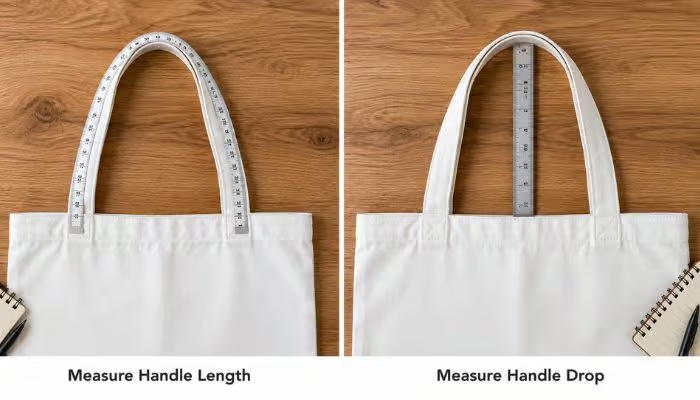
To measure the handle length, place one tote bag handle in its natural upright position above the opening. Use a flexible measuring tape and follow the center line of the handle from the point where it joins the bag body on one side to the matching attachment point on the other side. For handles sewn inside the body panels, measure only the visible finished section unless the concealed length is also required.
For the handle drop length, keep the handle upright and position a ruler vertically from the top edge of the tote bag opening to the highest inner point of the loop. This distance shows the usable clearance above the bag body. Check both handles separately when the tote bag has a pair to confirm that their length and drop remain consistent.
Step 4: Record Final Dimensions
After measuring each part, organize the tote bag dimensions in a fixed order and use one unit throughout the specification. Write the body size as width × height × depth, then list the handle measurements separately. Choose either centimeters or inches for the full record. When conversion is required, use 1 inch = 2.54 centimeters and keep the rounding method consistent.
For example, a complete measurement record can include:
- Tote bag size: 38 cm W × 42 cm H × 10 cm D
- Handle length: 60 cm
- Handle drop: 27 cm
- Handle width: 2.5 cm
What Are Common Tote Bag Dimensions?
Tote bag dimensions are normally expressed as width × height × depth. Together, these measurements define the visible proportions, internal capacity, opening size, and the way the bag expands when filled. Small, medium, large, and oversized totes therefore support different packing volumes and product arrangements.

Small Tote Bag
A small tote bag commonly measures around 25–30 cm W × 25–30 cm H × 6–8 cm D. Its compact proportions suit cosmetics, stationery, brochures, accessories, small gifts, and lightweight retail products. The shorter height also keeps the contents easy to reach and prevents the bag from looking oversized when only a few items are packed inside.
This format works best for flat or neatly arranged products. A gusset of 6–8 cm gives the small tote bag more usable space while preserving its compact profile. The finished shape remains relatively slim, so this size looks proportionate when the bag carries only a limited number of items.
Medium Tote Bag
Medium tote bags often measure approximately 35–40 cm W × 38–40 cm H × 10–15 cm D. This range can accommodate A4 documents, books, bottles, folded clothing, packaged goods, and mixed promotional materials without creating the bulk of a large tote. It is also a flexible starting point for projects that need both carrying space and manageable proportions.
The depth has a noticeable effect on the finished profile of a medium tote bag. A 10 cm gusset keeps the body relatively flat and compact, making the bag easier to fold and carry close to the body. A depth closer to 15 cm creates a broader base and more front-to-back space, allowing the tote to hold thicker or upright items while developing a fuller three-dimensional shape.
Large Tote Bag
Large tote bag dimensions typically range from 45–50 cm W × 38–45 cm H × 15–20 cm D. This wider, deeper design can accommodate groceries, towels, clothing, larger gift sets, product boxes, or several items packed together. The broad opening also makes loading bulkier contents more convenient.
The wider body and deeper base create considerably more internal volume than a medium tote bag. A gusset of 15–20 cm allows several items to sit together across the base, while the side and bottom panels expand more fully when loaded. This gives the large tote bag a more substantial three-dimensional form without reaching oversized proportions.
Oversized Tote Bag
An oversized tote bag often measures about 55–65 cm W × 45–50 cm H × 20–25 cm D. Its generous interior suits beach items, outerwear, bedding, large retail packages, event kits, or several lightweight products grouped together. The expanded front panel also gives the bag a stronger visual presence than smaller tote formats.
The larger front panel creates strong visual space for branding, but the overall proportions must remain practical. Handle drop, opening width, base support, folding method, and carton volume should all be reviewed during sampling so the finished tote remains balanced and manageable when filled.
| Tote Bag Size | Typical Dimensions (W × H × D) | Common Fit |
| Small | 25–30 × 25–30 × 6–8 cm | Cosmetics, stationery, brochures, and small gifts |
| Medium | 35–40 × 38–40 × 10–15 cm | A4 documents, books, bottles, and folded clothing |
| Large | 45–50 × 38–45 × 15–20 cm | Groceries, towels, gift sets, and product boxes |
| Oversized | 55–65 × 45–50 × 20–25 cm | Beach items, bedding, event kits, and large packages |
How Does Tote Bag Structure Affect Measurements?
Tote bag structure determines where each measurement begins and ends. Flat, gusseted, box-shaped, tapered, and zippered designs use different panel layouts, so width, height, and depth cannot always be measured from the same points. The bag should therefore be identified by structure before its dimensions are taken.
Flat Tote Bags
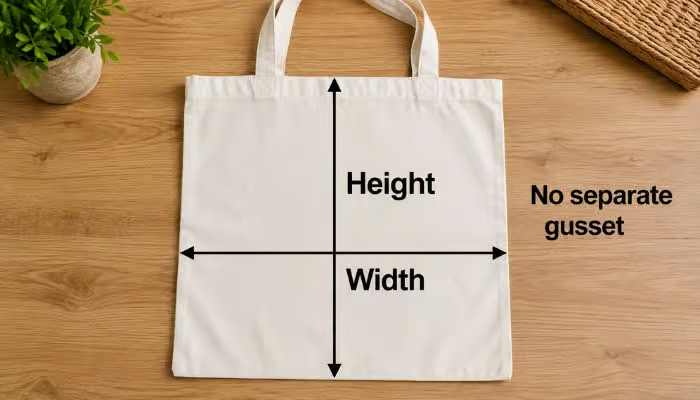
A flat tote bag normally consists of front and back panels joined along the sides and bottom. Measure the width horizontally between the two side seams and the height vertically from the finished bottom edge to the top opening. Since the bag has no separate gusset, the specification usually includes only width and height.
The bag may still gain a small amount of space when the fabric bends around the contents, but this expansion does not count as a true depth measurement. A flat tote should not be given an estimated gusset simply because it becomes wider when filled. Its usable space mainly depends on the panel dimensions and fabric flexibility.
Side-Gusseted Tote Bags
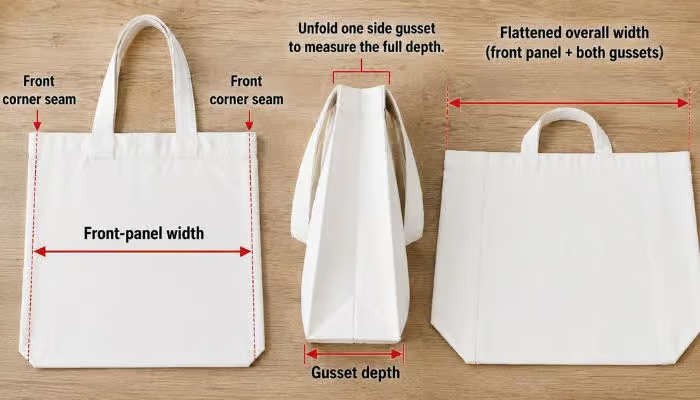
Side-gusseted tote bags include folded sections between the front and back panels. Use the two front corner seams to define the front width, then unfold one side section to determine the full distance between the front and back panels.
The flattened overall width may include the front panel plus both folded gussets, so it can be larger than the stated body width. For example, a tote with a 35 cm front width and two folded side sections may appear much wider when laid flat. The specification should separate front-panel width from gusset depth.
Box-Shaped Tote Bags

A box-shaped tote bag uses separate front, back, side, and bottom panels to form a defined three-dimensional body. Take the width across the finished front panel, the height from the base edge to the top opening, and the depth across one complete side panel. The bottom panel should also be checked because its length and width determine the base area and should correspond with the front width and side depth.
These measurements must follow the completed seam lines rather than the original cutting-panel sizes. Piping, binding, raised corners, lining, and seam allowances can increase the outside dimensions while reducing the usable space inside. For this reason, a box-shaped tote bag may require both external and internal measurements.
Tapered and Zippered Tote Bags

Top and bottom widths differ on a tapered tote bag, so one horizontal measurement cannot describe the complete shape. Record the top opening width and bottom width separately, then take the height through the center of the body. The changing side angle explains how the body narrows or widens from one end to the other.
For a zippered tote bag, the usable opening should be checked along the finished zipper line. Zipper stops, fabric extensions, and recessed zipper panels may reduce the accessible width even when the body itself is wider. The body may have enough internal space for an item, but the item must also pass through the finished zipper opening.
Choosing Tote Bag Dimensions for Different Industries
Industry requirements influence tote bag dimensions through product presentation, distribution methods, storage conditions, and the way the bag moves through each sales or service process. Rather than selecting a size from capacity alone, you should consider the operating conditions specific to your sector.
Retail and Grocery

Retail and grocery tote bag dimensions around 40–45 cm W × 35–40 cm H × 15–18 cm D provide a broad opening and enough base space for quick checkout packing. The moderate height keeps products visible, while the wider body allows staff to arrange mixed purchases without stacking everything vertically.
A box-shaped tote bag with full side and bottom gussets offers the most practical construction for this setting. Its defined base spreads the packed contents across the bottom and helps upright items remain stable. Compared with a flat tote, this structure also opens more fully and gives staff better access during packing.
Trade Shows and Corporate Events

Crowded exhibition halls favor a slimmer tote bag that stays close to the body. A size near 36–40 cm W × 38–42 cm H × 8–10 cm D provides vertical room for event materials without creating a deep profile that becomes inconvenient during prolonged carrying.
Flat construction works well when the event pack mainly contains brochures or documents. When notebooks, samples, or small gifts add thickness, a shallow side gusset provides extra space without turning the tote bag into a bulky shopping style. The reduced depth also makes large quantities easier to stack before distribution.
Education and Publishing

Printed material dimensions should set the starting point for education and publishing projects. A tote bag measuring approximately 36–40 cm W × 40–42 cm H × 10–12 cm D leaves suitable clearance around A4 folders, books, and course materials while keeping their upper corners below the opening.
Rather than using a completely flat body, this sector benefits from a side-gusseted tote bag with a rectangular bottom section. The gusset accommodates the combined thickness of several publications, while the defined base supports stacked materials more evenly and reduces concentrated pressure along one lower edge.
Hospitality and Tourism

Welcome packs, travel materials, and lightweight guest items often require more flexibility than a compact retail bag. Dimensions around 42–48 cm W × 38–42 cm H × 14–18 cm D create useful capacity without reaching the scale of an oversized beach tote bag.
A soft tote bag with side and bottom gussets can expand when filled and fold relatively flat when empty. This flexibility supports front-desk storage, room placement, and transport between locations. A rigid box construction may occupy more storage space, while excessive depth can feel awkward in elevators, vehicles, and narrow public areas.
Beauty and Lifestyle Brands

Compact proportions usually create a stronger presentation for beauty and lifestyle product sets. A body size of about 32–36 cm W × 30–34 cm H × 10–12 cm D keeps smaller packaged products visually connected and prevents the arrangement from looking lost inside an oversized tote bag.
For coordinated sets, a compact box-shaped structure provides a flat base and clearer product positioning. Bottles, cartons, and accessories can remain arranged instead of sliding toward the center. Softer lifestyle collections can use the same body dimensions with lighter side gussets when the brand prefers a more relaxed silhouette.
How to Choose the Right Tote Bag Dimensions?
Choosing tote bag dimensions requires more than selecting a standard size. The final specification should match the packed contents, loading direction, carrying position, artwork layout, expected weight, and shipping plan. A suitable tote bag provides enough working space without adding unnecessary fabric, depth, reinforcement, or packing volume.
Match the Size to the Contents
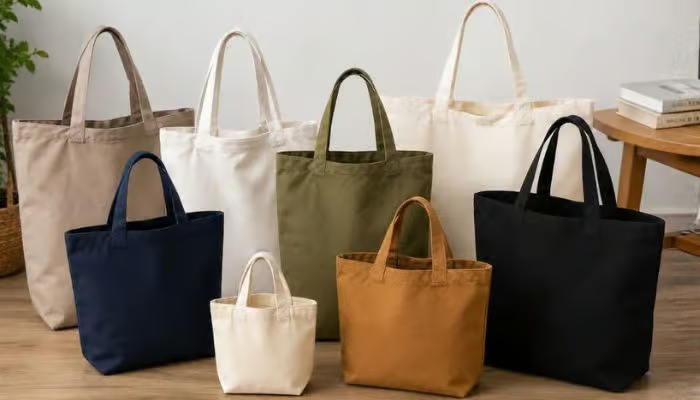
Start with the complete product set rather than a single item. Arrange boxes, bottles, documents, clothing, or accessories in the same position planned for packing, then check the total width, height, and front-to-back thickness. This approach gives a more accurate size reference because stacked, compressed, or grouped products occupy space differently.
Leave suitable clearance around the contents so staff can place and remove them without forcing the bag body. Soft textiles can follow the packed dimensions closely, while rigid cartons, folders, and containers need additional room around their edges. The tote bag should fit the actual product arrangement, not just the dimensions listed for the largest item.
Allow for Loading and Gusset Depth
Loading conditions determine whether the products can enter the tote bag smoothly and settle into the intended position. Flat materials may slide into a shallow design, while boxed sets, bottles, or several products placed in layers need a wider opening and more front-to-back space. The packing sequence also matters when staff must load multiple items quickly.
Gusset depth should reflect the thickness of the completed arrangement after everything reaches the base. Insufficient depth can push the front and back panels outward or make packing difficult. Excessive depth may leave the contents unstable and increase the folded size. Choose enough gusset space for smooth loading and an orderly final layout, rather than aiming for maximum capacity.
Match the Handles to the Carrying Style
The intended carrying method should guide the handle length, width, and drop. Shorter handles suit hand carrying, medium drops provide room for the forearm, and longer loops allow the tote bag to sit on the shoulder. As a general reference, shoulder-carry handles often measure around 53–66 cm in total length, although the required clearance also depends on body width and fill level.
Strap width becomes more important as the expected load increases. Narrow handles may suit lightweight promotional materials, while books, bottles, or retail products can require wider webbing to spread pressure more evenly. Attachment positions should also leave enough access to the opening without making the tote bag feel unbalanced when carried.
Check the Printing Area and Bag Proportions
Place the finished logo or artwork on a scaled tote bag drawing before approving the body size. Remove the areas occupied by the top hem, side seams, handle attachments, gusset folds, pockets, piping, and closures. The remaining uninterrupted panel space represents the practical printing area rather than the full width and height of the front panel.
Compare this usable area with the required artwork dimensions. A wide logo may require additional body width, while a vertical graphic may need more height. However, enlarging only one direction can make the tote bag look unusually narrow or flat. Adjust the width and height together until the artwork fits clearly and the overall proportions remain balanced.
Balance Size, Load, and Packing Cost
After confirming a workable tote bag size, calculate the expected packed weight and check whether the proposed construction can support it. A larger body may require heavier fabric, wider handles, reinforced attachment stitching, stronger seams, lining, or an added bottom panel. These changes increase both material use and sewing work, so the quotation may rise by more than the cost of the additional fabric alone.
Compare two or three suitable dimensions by reviewing fabric consumption, reinforcement needs, folded thickness, individual packaging, pieces per carton, and freight volume. For air freight and express delivery, carriers may calculate charges using dimensional weight, so lightweight tote bags can still cost more to ship when they occupy bulky cartons.
What Tote Bag Dimension Details Should Be Confirmed for Custom Production?
Custom production needs more than a basic width, height, and depth. The specification should also define the unit, measurement points, dimension type, acceptable tolerance, and approved sample reference. These details allow the design, quotation, pattern, inspection, and bulk production files to follow the same tote bag dimensions.

Dimension Format and Units
Write the tote bag body size in a fixed order, usually width × height × depth, and label the sequence clearly on the specification. Handle length, handle drop, strap width, pocket size, and opening width should appear as separate figures rather than being added to the main body dimensions.
Choose centimeters or inches for the complete project and apply that unit to drawings, quotations, samples, and inspection records. For example, write 38 cm W × 42 cm H × 10 cm D, not simply “38 × 42 × 10.” When a customer drawing uses inches, and the factory works in centimeters, both versions should show the same rounding rule to prevent small conversion differences.
Measurement Points on the Drawing
A dimension drawing should show exactly where every arrow begins and ends. The width may run between side seams, corner folds, or outer edges, depending on the tote bag structure. Height may start at the bottom seam, the lowest finished point, or the base panel edge. Written figures alone cannot explain these distinctions clearly.
Front, side, bottom, or top views may be needed for gussets, tapered panels, piping, recessed zippers, or unusual handle attachments. The ISO 129-1 principles for presenting dimensions and tolerances offer a useful reference for clear drawing layouts. Place each value beside the correct view and use matching letters for similar measurements. This prevents the same tote bag measurement from being interpreted from different reference points.
Finished and Internal Dimensions
Finished dimensions describe the outside size of the completed tote bag, including its sewn body, seams, piping, binding, and other construction details. Internal dimensions refer to the usable space inside the tote bag after lining, padding, seam allowances, closures, and folded panels reduce the available area. These two measurements should not be treated as interchangeable.
When both values matter, show them separately on the specification. For example, state finished external width: 40 cm and usable internal width: 38.5 cm rather than placing both figures beside one dimension line. The drawing should also confirm whether the quoted width, height, and depth refer to the outside body or the inside packing space.
Size Tolerance
Sewn tote bags cannot follow the same dimensional control as rigid molded or machined products. Fabric can stretch, shrink, compress, or shift during cutting, printing, sewing, pressing, and packing. The specification should therefore state an acceptable tolerance for the body, gusset, handles, pockets, and other dimensions that affect product fit.
The tolerance should reflect the material, construction, bag size, and importance of the measurement. A project may accept ±0.5 cm, ±1 cm, or another agreed range, but these figures are project-specific rather than universal standards. Dimensions affecting a fitted insert or zipper opening may require tighter control than a decorative pocket position.
Sample Dimension Approval
Before bulk production begins, compare the tote bag sample with the latest dimension drawing. Review the width, height, gusset, opening, handles, pockets, and any dimensions linked to the packed contents. The inspection should also confirm that the sample was measured using the same reference points defined in the specification.
Record the approved tote bag dimensions, required revisions, and final sample version in one document. When any measurement changes after sampling, update the drawing and size sheet instead of relying on separate email comments. The approved tote bag sample and revised dimension specification should become the reference for bulk production and final inspection.
Common Mistakes When Measuring a Tote Bag
Measurement errors can change the recorded proportions of a tote bag even when the difference appears small. Once an incorrect figure enters the drawing or specification, it may affect pattern development, sample approval, product fit, and bulk inspection. The main risk is not the inaccurate number alone, but the production decisions made from that number.

Including Handles in the Height
Counting the handles as part of the tote bag height makes the body appear taller than it actually is. This can distort panel dimensions, logo placement, capacity estimates, and carton planning, especially when one team checks body height while another uses total hanging height. Measure the bag body from the finished bottom edge to the top opening, then list the total height including handles as a separate figure only when the project requires it.
Ignoring Top and Bottom Widths
A tapered tote bag cannot be described accurately with a single width when the opening and base follow different dimensions. Leaving out one figure may change the side angle, restrict the loading opening, or produce a bottom panel that does not support the packed contents. Record the top width and bottom width separately, and place each value beside the correct edge on the drawing.
Measuring the Gusset Incorrectly
An inaccurate gusset measurement changes both the internal depth and the filled shape of the tote bag. Using only one folded half can create a shallower sample with limited space, while overstating the depth adds unnecessary fabric, loose movement, and folding volume. Open the gusset to its natural finished position and take the full distance between the front and back panels, checking side and bottom gussets separately when their dimensions differ.
Using the Wrong Edge
Piping, binding, seam lines, and folded corners can create several possible starting points around the same tote bag. When different teams select different edges, the sample, inspection report, and repeat order may show conflicting measurements even though everyone follows the same numerical specification. Mark the exact start and end points with arrows on the approved drawing, then use those same finished edges during sampling and inspection.
Stretching the Bag During Measurement
Pulling the fabric under tension can make the tote bag body, gusset, or handles appear larger than their natural finished size. Bulk pieces checked in a relaxed condition may then look undersized, or the factory may enlarge the pattern to match an inflated sample reading. Lay the tote bag on a level surface, smooth only loose wrinkles, and keep the material relaxed so every sample is measured under the same condition.
Work With Gentle Bags to Customize Tote Bags With the Right Dimensions
Gentle Bags can help turn your product size, packing plan, reference sample, or design drawing into a clear tote bag specification. Our team reviews the body proportions, gusset depth, opening width, handle drop, print area, and expected load before sampling, so each measurement supports the intended use and production method.
Share your product dimensions, artwork, target quantity, material preference, and packing requirements with us. We can recommend a practical tote bag size, prepare a sample for approval, and confirm the final measurements before bulk production. Contact us to develop a custom tote bag that fits your products, branding, and order plan.
Conclusion
Accurate tote bag measurements give you a dependable basis for comparing sizes, reviewing structures, selecting suitable proportions, and checking samples. Width, height, depth, opening size, and handle dimensions should always follow clear reference points, especially when the tote bag includes gussets, tapered panels, zippers, or structured bases.
The right tote bag dimensions should reflect the contents, loading process, carrying style, artwork area, expected weight, and total project cost. By testing these factors before bulk production, you can reduce size misunderstandings, improve product fit, and keep the approved tote bag specification consistent from sampling through repeat orders.
FAQs
1. What is the standard size for a tote bag?
A practical reference size for a general-purpose gusseted tote bag is approximately 35–40 cm W × 38–40 cm H × 10–15 cm D. For a flat tote without a gusset, a size near 38 cm W × 42 cm H is also commonly used. The structure should therefore be stated together with the dimensions.
2. What is the most popular tote size?
A popular medium tote bag size is approximately 38 cm W × 40 cm H × 12 cm D. This proportion offers enough room for clothing, bottles, and mixed promotional items while remaining practical to carry, fold, store, and pack into cartons.
3. Can two tote bags with the same dimensions have different capacities?
Yes, two tote bags with the same listed dimensions can provide different usable capacities. Seam allowances, lining thickness, padding, gusset construction, tapered panels, closures, and internal pockets can all reduce or reshape the available packing space.
4. What tote bag size can fit A4 documents or folders?
A tote bag around 35–38 cm W × 38–42 cm H × 8–12 cm D can comfortably fit A4 documents, folders, workbooks, and similar printed materials. This size leaves enough clearance around the edges and provides additional depth when several folders or publications need to be packed together.
5. How do you convert tote bag dimensions from inches to centimeters?
Multiply each inch measurement by 2.54 to convert tote bag dimensions into centimeters. For example, a bag measuring 15 × 16 × 4 inches equals approximately 38.1 × 40.6 × 10.2 cm. Keep the same rounding method across the full specification.
6. Do cotton tote bag dimensions change after washing?
Yes, cotton tote bag dimensions can change after washing, especially when the fabric has not been pre-shrunk. Water temperature, drying method, weave, fabric weight, and finishing treatment can affect the final shrinkage, so washable projects should be tested before bulk production.
7. Should seam allowance be included in finished tote bag dimensions?
No, finished tote bag dimensions should normally describe the completed size after the seam allowances have been sewn inside. Seam allowance belongs to the cutting pattern and production file, while the specification should state the visible external dimensions or usable internal dimensions separately.