
PU leather and faux leather often appear as separate material choices, yet the terms do not describe two completely independent categories. This creates confusion when you compare bag materials, request samples, or review supplier quotations. PU leather is one type of faux leather, while faux leather can include several synthetic constructions with different performance, costs, and surface characteristics.
Last Updated on September 23, 2026, by Gentle Bags Team
For bag sourcing, the label alone does not tell you which material will perform better. This guide compares PU leather vs faux leather in composition, flexibility, durability, cost, environmental impact, quality factors, and suitability for different custom bag applications.
Is PU Leather the Same as Faux Leather?

PU leather is a specific sub-category within the broader faux leather family, meaning every PU leather bag is technically a faux leather bag, but not all faux leather products are made from PU. In global manufacturing and supply chains, “faux leather” works as a general term for synthetic materials designed to replicate the appearance and texture of natural leather without using animal hides.
PU leather belongs to this category because it uses a polyurethane surface coating bonded to a textile backing. Therefore, the two terms describe a category-and-subcategory relationship rather than two separate material groups. Faux leather includes different synthetic leather constructions such as PVC-based materials, microfiber leather, and other alternatives, while PU leather represents a widely used option when a softer feel, flexible handling, and leather-like appearance are required.
What Is PU Leather?

PU leather is a synthetic leather material made with a polyurethane (PU) coating applied to a textile backing. The polyurethane layer creates a leather-like surface, while the backing provides the material’s basic structure and support.
PU leather is widely used in products that require a leather-like appearance, consistent texture, and flexible design options. Common applications include bags, wallets, footwear, clothing, furniture upholstery, automotive interiors, and other consumer goods.
Compared with natural leather, PU leather offers more consistent surface patterns and can be produced in different colors, finishes, and textures. These characteristics make it a common alternative material for manufacturers developing products with specific appearance, cost, and performance requirements.
What Does Faux Leather Actually Mean?

Faux leather is a broad term for synthetic materials designed to imitate the look and feel of natural leather without using animal hides. Unlike PU leather, which refers to a specific polyurethane-based construction, faux leather refers to a broader category of artificial leather alternatives.
Faux leather is produced by applying a synthetic coating onto a textile backing to create a leather-like surface. The coating formulation, backing structure, material thickness, and finishing process can vary depending on the intended application and required performance. Common faux leather materials include:
- PU leather: Uses polyurethane as the main surface coating and is known for its soft feel and flexible appearance.
- PVC leather: A synthetic leather material with a polyvinyl chloride coating, often selected for applications requiring strong surface resistance.
- Other synthetic leather alternatives: Include microfiber leather, which uses a microfiber base and resin coating to provide higher strength and a more leather-like feel.
PU Leather vs Faux Leather: Key Differences
The main differences between PU leather and faux leather relate to material composition, flexibility, durability, cost, and environmental impact. Since PU leather is one type of faux leather, the comparison depends on the specific faux leather material being evaluated. The following sections compare these key factors to help you understand how PU leather differs from other faux leather options and make a more informed material choice.
| Comparison Factor | PU Leather | Faux Leather |
| Material Structure | Uses a polyurethane coating with a textile backing, creating a flexible synthetic leather structure | Refers to a wider group of synthetic leather materials, including PU, PVC, microfiber, and other constructions |
| Breathability | Generally limited; varies with coating thickness and backing | Varies by construction; microfiber may improve airflow, while PVC is generally less breathable. |
| Softness and Flexibility | Softer hand feel, smoother touch, and better bending flexibility | Often has a firmer feel, especially in rigid synthetic leather constructions |
| Durability and Longevity | Better resistance to repeated bending and folding; may experience hydrolysis under prolonged high humidity | Some types provide stronger surface hardness and scratch resistance but may become less flexible over time |
| Price Range | Positioned as a mid-to-upper synthetic leather option with a better leather-like feel | Ranges from low-cost synthetic options to premium alternatives with upgraded structures |
| Environmental Considerations | Animal-free material; some options use water-based coatings or reduced-VOC formulations | Environmental performance differs by material type, such as PU, PVC, microfiber, or recycled synthetic leather |
Material Structure, Softness, and Flexibility

PU leather and other faux leather materials differ mainly in their coating chemistry and material structure. PU leather uses a polyurethane-based surface layer, while PVC-based faux leather uses a polyvinyl chloride coating system.
Polyurethane has a more flexible polymer structure, which allows PU leather to maintain a softer touch and better bending performance. This characteristic makes PU leather suitable for handbags, crossbody bags, wallets, and other accessories that require frequent handling, curved shapes, and a more natural leather-like feel.
Other faux leather materials may use different coating systems and structures that create a firmer surface with higher rigidity. Such materials can be suitable for structured products such as travel luggage, protective cases, furniture covers, and bags that require a more stable form. However, firmer constructions may provide less flexibility for soft-structured products that require frequent folding or natural drape.
Breathability and Airflow
PU leather and most other faux leather materials have limited breathability because their synthetic coatings restrict airflow through the surface. The actual level depends on coating thickness, backing structure, and overall material construction.
Some microfiber-backed synthetic leathers may provide slightly better airflow, while PVC-based faux leather generally has lower breathability because of its denser coated surface. This difference matters more in products that stay in prolonged contact with the body, such as apparel, footwear, or wearable accessories.
Durability and Longevity
PU leather usually performs better than lower-grade faux leather in flexibility and resistance to cracking under repeated bending. This makes it suitable for high-contact areas such as bag handles, shoulder straps, corners, and frequently used accessories. With proper care, quality PU leather bags can maintain their appearance for several years.
However, durability varies significantly among faux leather types. PVC-based faux leather may offer stronger surface resistance against scratches and punctures but can become stiff over time due to plasticizer migration. PU leather has a different weakness: prolonged exposure to humidity and heat can cause hydrolysis, which may lead to surface peeling or stickiness in lower-quality materials.
Price and Cost Range
PU leather usually sits in a mid-range position among synthetic leather materials, offering a balance between appearance, flexibility, and cost. Its polyurethane coating process generally creates a more leather-like feel and finish than many entry-level synthetic alternatives. So PU leather is a common choice for products that require a better balance between material performance and production cost.
Faux leather covers a wider range of materials and price levels. Basic faux leather materials can reduce cost by using simpler coating systems and surface treatments, while premium synthetic leather options may increase cost through thicker structures, advanced finishes, or improved performance features.
Environmental Impact
PU leather and faux leather are both synthetic materials, and neither category is automatically environmentally friendly. For international markets, compliance requirements such as REACH help evaluate chemical safety, while environmental performance depends on raw materials, production processes, and end-of-life options.
As a type of faux leather, PU leather avoids animal hides and traditional tanning processes used for genuine leather, which can reduce some environmental concerns associated with animal-based leather production. However, PU still relies on polyurethane polymers, and its overall impact varies depending on manufacturing methods and material formulation.
Environmental performance also varies across other faux leather constructions. For example, PVC-based materials have attracted attention due to concerns related to certain additives and recycling challenges, while newer synthetic leather solutions may incorporate recycled content, bio-based materials, or improved production technologies.
What PU Leather and Faux Leather Have in Common?

PU leather and other faux leather materials share several characteristics that make them widely used as alternatives to genuine leather. While their structure and performance may differ, both provide leather-inspired aesthetics, flexible design options, easier maintenance, and cost advantages for fashion, accessories, and commercial products.
- Leather-like appearance: Designed to replicate the visual characteristics of genuine leather, these materials can feature realistic grain patterns, smooth surfaces, embossed textures, and refined finishes for different product styles.
- Wide range of colors and finishes: Available in extensive color selections and surface treatments, synthetic leather materials can support metallic effects, glossy coatings, matte textures, and customized appearances for different brand directions.
- Easy cleaning and maintenance: The coated surface helps reduce the impact of daily dust, light stains, and minor spills. Most PU and faux leather surfaces can be cleaned with a soft damp cloth and mild soap, although care requirements may vary by coating and finish.
- Lower-cost leather alternatives: Offering a balance between appearance and production cost, PU leather and other faux leather options allow brands to achieve leather-style designs at more accessible price points.
Factors That Affect PU and Faux Leather Quality in Bag Production
The quality of PU leather and faux leather depends on more than the material category. In bag production, factors such as coating formulation, backing structure, surface finish, and layer bonding directly influence the material’s hand feel, durability, appearance, and performance during use. The following sections explore the key factors that determine the quality and consistency of synthetic leather used for bags.
Coating Formulation and Thickness

The coating formulation refers to the composition of the surface layer, including the type of resin, fillers, pigments, and performance additives used to achieve specific material properties. Its thickness also plays an important role in how PU leather and faux leather perform during bag production and daily use.
Higher-grade synthetic leather usually uses a more stable resin formulation with fewer fillers, helping the surface maintain better elasticity and appearance during repeated bending. Lower-grade materials may use excessive fillers to reduce cost, which can make the coating less flexible and more prone to problems such as whitening, cracking, or surface damage after repeated folding.
- 0.6–0.8 mm: Lightweight and flexible, suitable for soft pouches, fashion accessories, and products requiring a softer drape.
- 0.8–1.2 mm: A common range for shoulder bags, backpacks, and general bag applications, providing a balance between flexibility, structure, and wear resistance.
- 1.2–1.5 mm or above: Thicker constructions provide stronger support and surface protection, suitable for structured bags, luggage-style products, and applications requiring better shape retention.
Backing Fabric Type and Tensile Strength
The backing fabric structure directly affects the tensile strength, dimensional stability, and overall performance of PU leather and faux leather used for bags. While the surface coating creates the appearance and touch, the backing layer provides the internal support that helps the material resist stretching, tearing, and deformation during bag production and daily use.
- Polyester backing: Provides high tensile strength and dimensional stability, helping synthetic leather maintain panel shape during cutting, stitching, and repeated handling.
- Cotton or cotton-blend backing: Offers a softer and more flexible structure with a natural feel, but offers less resistance to stretching compared with stronger synthetic backings.
- Microfiber backing: Creates a denser internal structure with improved strength and a more leather-like feel, making it suitable for premium synthetic leather applications that require both flexibility and durability.
Surface Finish, Grain, and Color Consistency
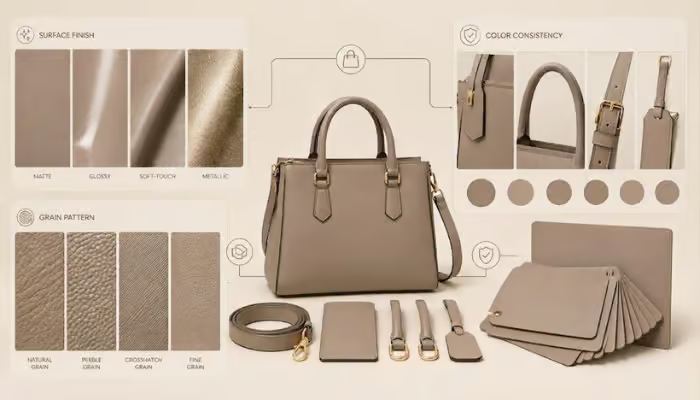
Surface finish, grain pattern, and color consistency determine the appearance, touch, and production consistency of PU leather and faux leather used for bags. Stable surface control helps different panels, handles, straps, trims, and production batches maintain a unified appearance and match the approved design.
- Surface finish: Controls the final visual effect and hand feel of synthetic leather. Options such as matte, glossy, soft-touch, and metallic finishes create different appearances and tactile experiences for various bag designs.
- Grain pattern: Defines the surface texture and leather-like character of the material. Common patterns include natural leather grain, pebble grain, crosshatch grain, and fine grain, allowing brands to achieve different styles and textures.
Adhesion, Flexing, and Abrasion Performance
Adhesion, flexing, and abrasion performance influence how PU leather and faux leather maintain their structure and appearance during bag production and daily use. Strong bonding between the coating layer and backing fabric helps prevent peeling or delamination during cutting, stitching, folding, and handling, especially around stress areas such as seams, handles, and strap attachment points.
Flexing performance allows synthetic leather to withstand repeated bending without early cracking, surface whitening, or loss of texture, while abrasion resistance helps protect the grain pattern, color, and finish from continuous friction around areas such as bottom corners, folded edges, and frequently touched surfaces. Material durability can be evaluated through standardized methods such as Martindale or Taber abrasion testing depending on application requirements.
PU Leather vs Faux Leather: Which Is Better for Custom Bags?
The better material choice depends on the bag’s design, expected performance, target market, and product positioning. PU leather is often selected for bags that require a softer touch and leather-like appearance, while other faux leather options may be considered when specific surface performance or cost targets are more important. For custom bag development, material selection should start with the product requirements.

Match the Material to the Bag’s Intended Use
The bag application should determine the material direction. PU leather is commonly selected for handbags, crossbody bags, wallets, laptop sleeves, and fashion accessories where appearance, softness, and a leather-like touch are important.
Other faux leather options may be considered for promotional bags, budget-friendly accessories, large-volume retail items, or products requiring specific surface characteristics. The intended customer, usage frequency, and design style should guide the final material selection.
Define the Required Bag Structure and Performance
The bag structure and functional requirements also affect material choice. Soft PU leather is often preferred for flexible bag structures such as hobo bags, crossbody bags, shoulder bags, and soft handbags, where the material needs to follow curved shapes and maintain a natural drape.
Thicker synthetic leather materials with higher rigidity and stronger surface support may be considered for more structured designs, including tote bags with reinforced panels, laptop bags, briefcases, messenger bags, and luggage-style bags, where shape retention and edge definition are more important.
Before selecting the material, consider factors such as bag size, panel thickness, reinforcement, lining, handle construction, zipper areas, and expected daily use. A suitable material should support the complete bag structure rather than only provide the desired appearance.
Consider Target Price and Product Positioning
Material selection should match the target price range and market positioning of the bag. PU leather is often chosen when brands want a balance between leather-like appearance, comfortable handling, and controlled material costs, while other faux leather options may be used for products with different cost or performance priorities.
- Entry-level: More cost-focused faux leather options can help control material expenses for promotional bags, large-volume collections, and budget-oriented products.
- Mid-range fashion: PU leather is commonly selected for handbags, crossbody bags, and accessories that require a more premium appearance without the cost of genuine leather.
- Premium synthetic leather products: Higher-grade synthetic leather materials with advanced textures, coatings, or structures can support elevated product positioning and improved user experience.
Compare Actual Material Specifications and Samples
Terms such as PU leather and faux leather describe general categories, but the final performance depends on the specific construction, thickness, finish, and backing structure. Before confirming production, review key material details such as:
- Material thickness: Check whether the thickness provides the required balance between softness, structure, and durability.
- Surface finish and grain: Confirm that the texture, gloss level, and color match the intended product design.
- Backing structure: Evaluate whether the backing fabric provides enough strength and stability for cutting, stitching, and daily use.
- Physical samples: Test the actual material through bending, touch evaluation, and appearance comparison before bulk production.
How Can You Identify PU Leather From Other Faux Leather?

You can identify PU leather from other faux leather by checking the material composition, surface feel, backing structure, and flexibility characteristics. While visual inspection can provide initial clues, the most accurate identification comes from comparing the actual material construction and performance.
- Check the material composition: PU leather uses a polyurethane coating layer, while other faux leather materials may use different synthetic coatings such as PVC or other composite structures.
- Evaluate the surface feel: PU leather has a softer touch and more flexible surface response, while harder synthetic leather constructions often feel firmer and less natural during handling.
- Inspect the backing structure: PU leather combines a textile backing with a polyurethane surface layer. Differences in backing density, texture, and internal structure can help distinguish different synthetic leather constructions.
- Test flexibility and recovery: PU leather bends more smoothly and maintains better surface appearance after repeated folding, while more rigid materials may leave stronger crease marks or show reduced flexibility.
For commercial sourcing, material documentation and physical samples provide the most accurate identification method. Visual inspection can support evaluation, but it should not replace specification confirmation before production.
Conclusion
PU leather and faux leather are not competing categories in the same way as two completely different materials. PU leather belongs to the faux leather family and is often chosen when a product needs a balance of leather-like appearance, softness, flexibility, and cost control. Other faux leather options may provide different advantages, such as stronger surface hardness or specific performance characteristics.
If you are developing custom bags and need support choosing the right synthetic leather, Gentle Bags can help evaluate suitable materials, finishes, and specifications based on your product requirements. Contact us to discuss your custom bag project and request material options for your next collection.
FAQs
1. Is PU leather a type of faux leather?
Yes. PU leather is a type of faux leather made with a polyurethane coating, while faux leather is a broader category that also includes PVC leather, microfiber leather, and other synthetic leather materials.
2. Is PU leather real leather?
No. PU leather is not real leather because it does not use animal hides. It is a synthetic material designed to replicate the appearance and feel of natural leather.
3. Which is more durable, PU leather or faux leather?
PU leather usually provides better flexibility and resistance to cracking, while some other faux leather constructions may offer stronger surface hardness. The better choice depends on the required balance between flexibility, wear resistance, and product use.
4. Does PU leather peel or crack easily?
Low-grade PU leather may peel or crack due to weak coating formulation, poor bonding, or prolonged exposure to humidity. Higher-grade PU leather with better material construction can maintain its appearance and performance for a longer period.
5. How long does PU leather last?
The lifespan of PU leather varies by material quality, usage conditions, and maintenance. Well-made PU leather products can maintain good appearance and performance for several years under normal use.