
Tool bags often share similar names, but their structures are not interchangeable in real use. When the wrong structure enters production, users may face slow tool access, poor weight balance, damaged tools, or early bag failure.
This guide explains the main types of tool bags and their functional design differences, so you can compare access, capacity, mobility, protection, and customization needs before choosing a structure for professional use or bulk production.
Why Tool Bag Type Matters for Professional Use?
Tool bags affect tool storage, jobsite movement, working efficiency, and long-term product value. A suitable tool bag helps users keep tools organized, reduce repeated searching, protect accessories during movement, and carry equipment more practically. For wholesale, retail, and team projects, these functions also influence customer satisfaction, repeat orders, and product positioning.

- Better organization: A well-planned tool bag separates hand tools, power tool accessories, cables, small parts, and personal items into clear storage areas, helping users keep a stable layout during repeated work.
- Improved work efficiency: Fixed tool positions reduce searching time during repair, installation, inspection, or maintenance tasks, especially for professional teams moving between different work areas or service locations.
- Stronger tool protection: Reinforced fabric, padded sections, secure closures, and stronger bottom structures help reduce impact, friction, and tool movement during transport.
- Easier movement: Different carrying structures help users move tools by hand, shoulder, waist, back, or wheels, making daily work more practical in job sites, warehouses, vehicles, or service routes.
- Higher product value for business projects: A tool bag with the right structure is easier to position for retail sales, branded tool kits, employee equipment, or promotional programs because it offers value beyond logo customization.
Main Types of Tool Bags and Their Functional Design Differences
Different tool bags are built around different storage habits, carrying methods, and work environments. Some designs focus on fast access, while others focus on heavier loading, hands-free movement, compact storage, or better tool protection. This section helps you compare the main tool bag types before moving into material, branding, or sample development.
Open-Top Tool Tote Bags
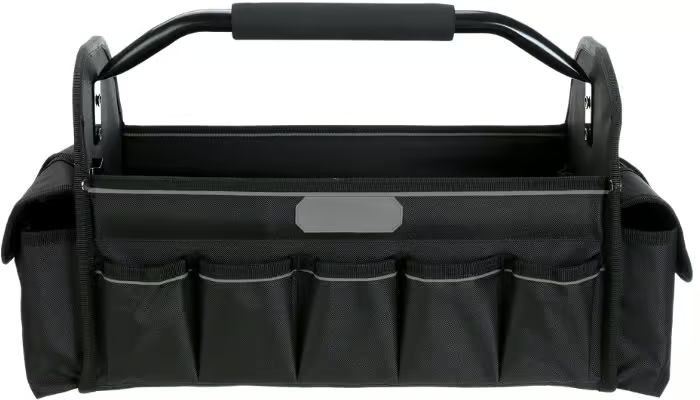
Open-top tool tote bags are wide-mouth tool bags designed for repair, installation, maintenance, and general service work. Users can place the bag beside the work area and take tools directly without opening a zipper, flap, or roll-up cover. Brands such as DEWALT and Milwaukee Tool also offer open-style tool bags designed for quick access during professional work.
Their most recognizable design features include a large central compartment, firm side panels, upright pocket zones, reinforced handles, and a stable bottom structure. Many tote bags for tools also use inner and outer pockets to separate screwdrivers, pliers, tapes, gloves, small fittings, and frequently used accessories while keeping larger tools in the main space.
Tool totes help users see tools clearly, return them quickly, and adjust storage during the day without a fixed slot layout. For custom tool bag projects, open-top totes suit maintenance kits, branded service bags, retail tool bag lines, and wholesale programs that need a simple structure with clear daily-use value.
Zippered Tool Bags
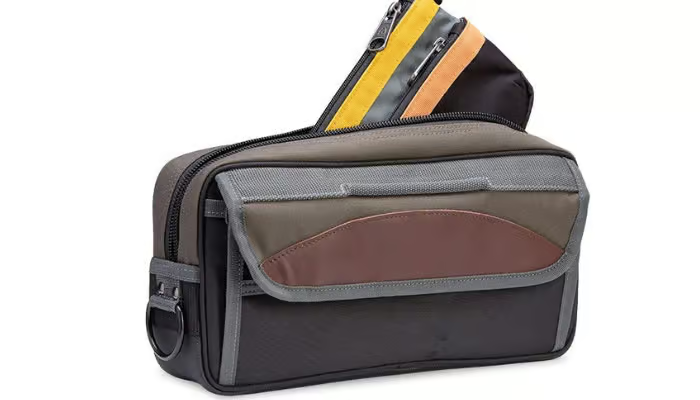
Zippered tool bags add a top closure system to the traditional open storage structure, creating a balance between quick access and safer tool storage. Once closed, the zipper helps keep tools secure during transportation while reducing exposure to dust, moisture, and external debris.
Most zippered tool bags use two-way zipper systems that allow users to open the bag from either side, making tool access more convenient in different working positions. Some upgraded designs include water-resistant zippers, sealed seams, or reinforced zipper panels to improve protection in demanding environments.
The interior usually combines tool compartments, elastic loops, and small-item pockets to keep different tools and accessories organized. This style tends to suit technicians who shuttle tools back and forth between a vehicle and a job site, particularly when the drive itself poses some risk of tools shifting or falling out along the way.
Tool Backpacks
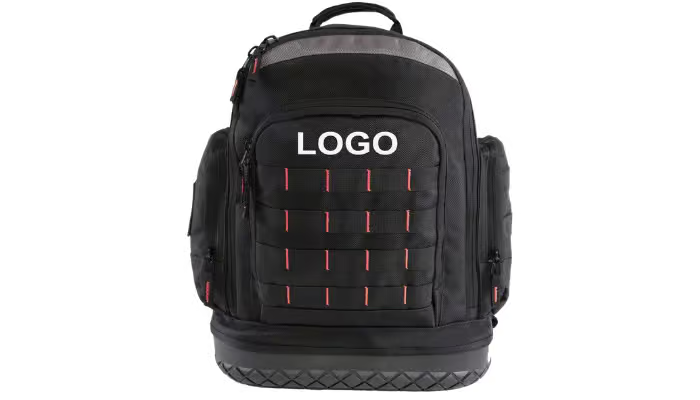
Tool backpacks are designed for users who need to carry tools while keeping both hands available for movement and operation. The backpack structure distributes the load across the shoulders and back, making it suitable for professionals who frequently move between different work areas.
Unlike standard storage bags, tool backpacks usually include a vertical organization system with multiple compartments, elastic tool loops, front pockets, and padded sections. Veto Pro Pac‘s Tech Pac backpack, for example, uses a patented center panel with dual bays and around 46 pockets, plus a waterproof molded base that keeps tools dry in rough conditions.
Some designs also add laptop compartments, document pockets, or dedicated spaces for meters and electronic equipment to support more complex service tasks. Reinforced straps and a padded back panel show up on most models too, since long hours of carrying weight on the shoulders can otherwise take a toll.
Rolling Tool Bags
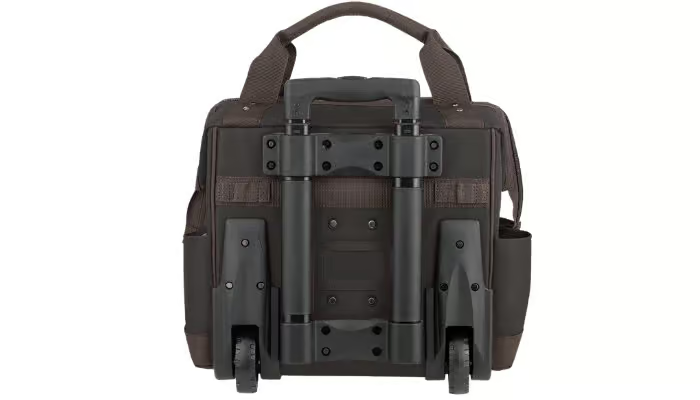
Rolling tool bags are designed for transporting large tool collections with less manual lifting. A wheel system and telescopic handle allow users to move the entire bag by pulling instead of carrying it, making this structure suitable for heavy-duty tool storage and frequent movement between different locations.
These bags usually feature larger storage capacity, multiple internal compartments, stronger load-bearing structures, and some models can even split apart into separate modules when needed. Many models use rubber wheels with bearing systems for smoother movement on uneven surfaces, while reinforced bases and strengthened side panels help support heavier loads during long-term use.
Tool Pouches
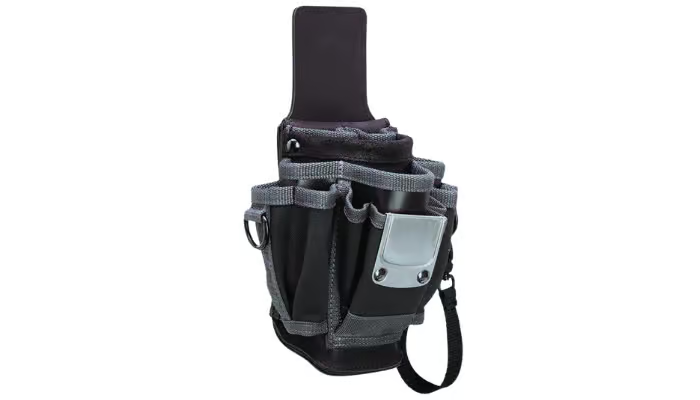
Tool pouches are compact storage solutions designed for carrying a small selection of frequently used tools and accessories. They are commonly attached to a belt or carried as an individual unit, allowing users to keep essential tools within immediate reach during repair, installation, and maintenance work.
A typical tool pouch focuses on small-item organization rather than large storage capacity. Multiple pockets, narrow sleeves, elastic holders, and secure closures help separate items such as screwdrivers, pliers, measuring tools, fasteners, and other frequently used accessories.
The compact layout also reduces the need to search through a larger tool bag for commonly used items. Because of their limited storage space, tool pouches are mainly used for essential hand tools rather than complete tool collections or heavy equipment.
Tool Belts
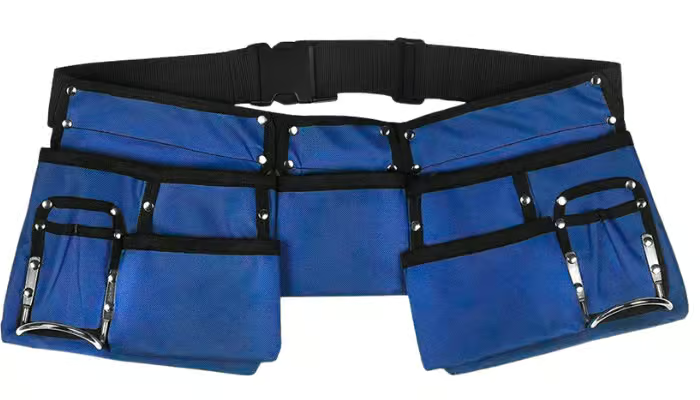
A tool belt takes the pouch concept a step further, combining multiple pouches, a hammer loop, and a tape measure holder into one system worn directly around the waist. By positioning different tools front, back, and to each side, a tool belt reduces the strain that comes from loading everything onto one hip.
Padded lining and adjustable suspension systems are common additions on the more professional versions, aimed at making all-day wear more bearable. Many belts are also modular, letting the wearer swap pouches in and out depending on what a particular job calls for. Carpenters, construction workers, and remodelers who spend most of the day standing, walking, and reaching for a wide variety of tools tend to prefer this format above the others.
Bucket Tool Bags
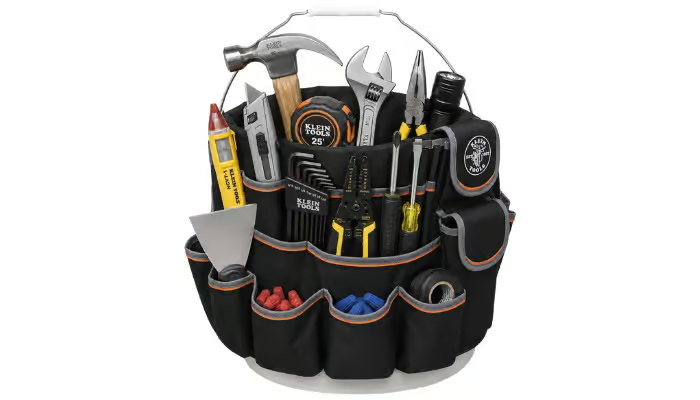
Bucket tool bags aren’t really bags in the traditional sense; they’re fabric sleeves that wrap around a standard round bucket, turning an ordinary container into a multi-purpose organizer. Pockets and loops sewn into the outside hold smaller tools, while the bucket itself still functions as a bucket, doubling as a seat or a place to toss scrap material.
The defining feature here is versatility: the interior can hold larger or heavier items, the exterior pockets handle the smaller stuff, and the open top means big tools can still be dropped in or pulled out without unzipping anything. Their open structure provides good visibility, but they are less suitable for situations that require fully enclosed storage or strong protection from dust and moisture.
Tool Roll Bags
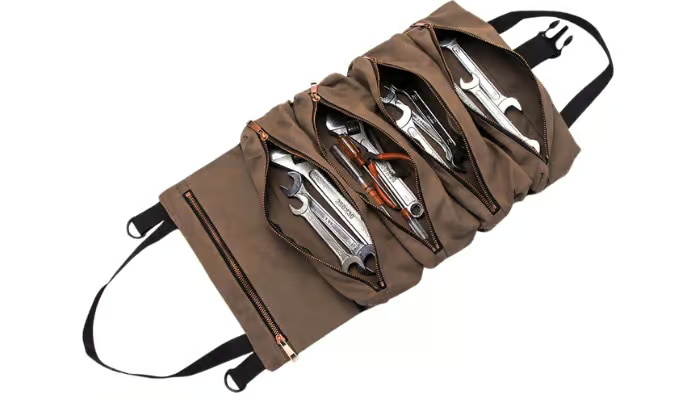
Tool roll bags are compact storage solutions designed with a flat layout that can be rolled up after tools are placed inside. Individual pockets, elastic loops, and securing straps keep tools such as wrenches, screwdrivers, knives, and repair accessories in separate positions, while the open layout allows users to see the complete tool set at once.
This fixed-position storage also helps with injury prevention. OSHA’s ergonomics guidance flags repetitive reaching and searching as a source of strain, and keeping each tool in a dedicated slot cuts down on that unnecessary movement.
This structure limits tool movement during transport and keeps small collections organized without much storage space. Rolled up, the bag fits easily into vehicles, drawers, larger tool bags, or equipment kits when not in use. Tool rolls work well for mechanic kits and compact tool sets, but their limited capacity makes them better suited to selected hand tools than to larger equipment or mixed sets.
Tool Bag Type Comparison Table
Each tool bag type has a different structure, storage method, and working purpose. A quick comparison helps you identify which design fits specific tool loads, mobility needs, and working conditions before making a selection.
| Tool Bag Type | Main Design Feature | Best For | Key Benefits | Main Limitation |
| Open-Top Tool Tote Bags | Wide opening with a large main compartment and external pockets | Maintenance work, service kits, general tool storage | Fast tool access and flexible storage layout | Limited protection from dust and falling objects |
| Zippered Tool Bags | Enclosed structure with zipper closure and organized compartments | Mobile technicians, repair teams, vehicle storage | Better tool security and cleaner storage | Requires more time to open and access tools |
| Tool Backpacks | Shoulder straps, back support, and vertical storage compartments | Field technicians, installers, electricians | Hands-free carrying and better mobility | Not ideal for extremely heavy tool loads |
| Rolling Tool Bags | Wheels, telescopic handle, reinforced base | Heavy tool transportation and large equipment sets | Reduces carrying pressure for heavy loads | Larger size makes narrow-space movement difficult |
| Tool Pouches | Compact pockets, loops, and belt attachment systems | Small repair tasks and frequently used tools | Lightweight and quick access | Limited storage capacity |
| Tool Belts | Waist-mounted pockets and holders | Construction, carpentry, installation work | Keeps essential tools within immediate reach | Cannot replace full tool storage |
| Bucket Tool Bags | Vertical pockets arranged around a bucket-style structure | Construction and maintenance environments | High visibility and easy tool organization | Less suitable for enclosed protection |
| Tool Roll Bags | Flat layout with individual slots and roll-up closure | Repair kits and compact hand tool sets | Space-saving storage and clear tool arrangement | Not suitable for large or mixed equipment collections |
How to Choose the Right Tool Bag for Different Work Needs?
Choosing the right tool bag starts with understanding the user’s tools, working environment, and daily movement needs. Before selecting a tool bag, consider several key factors, including tool weight, access frequency, mobility needs, working conditions, storage capacity, and carrying comfort. These factors help determine whether a user needs a compact solution for essential tools or a stronger structure for larger equipment collections.
Match the Bag Type to Tool Weight
Tool weight directly affects the suitable tool bag structure. Lightweight hand tools can usually be stored in compact designs, while heavier equipment requires stronger support, larger capacity, and better weight distribution to avoid damage to the bag or discomfort during use.
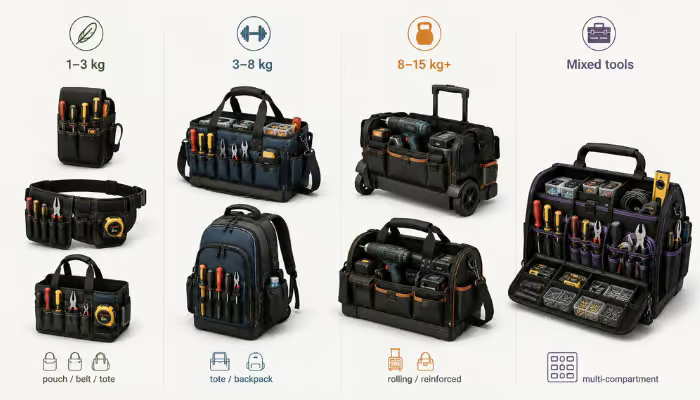
- Lightweight tools (1–3 kg): Tool pouches, tool belts, and compact tote bags work well for screwdrivers, pliers, measuring tools, and other frequently used hand tools that need quick access during daily tasks.
- Medium-weight tool sets (3–8 kg): Tool totes and tool backpacks provide the storage space and organization needed for technicians carrying multiple hand tools, accessories, and service equipment.
- Heavy tool loads (8–15 kg or above): Rolling tool bags and reinforced tool bags are better suited for drills, batteries, power tool accessories, and larger equipment because they provide stronger support and easier transportation.
- Mixed tool collections: Tool bags with multiple compartments and reinforced structures help separate different tool categories while maintaining better weight balance.
Consider Tool Access Frequency
Tools that are used repeatedly during a task should stay within quick reach, while less frequently used items can be stored in deeper compartments or secondary pockets. For different working habits, the tool bag structure should match how often users need to take out and return tools:
- Tools reached for constantly: A pouch, belt, or open-top tote keeps screwdrivers and pliers within arm’s reach without ever needing to unzip anything.
- Tools pulled out a few times a shift: A zippered bag adds a layer of protection while still keeping retrieval quick enough not to slow the job down.
- Equipment used once or twice per visit: Backpacks and rolling bags suit specialized gear or backups that don’t need to sit in an easy-access spot all day.
- A mix of both: Pairing a main bag with a small pouch or belt lets the essentials stay close while everything else stays packed away.
Check Mobility Requirements
The amount of walking, climbing, or repositioning a job requires determines whether hands-free carrying or wheeled transport makes more sense.
- Climbing ladders or working on scaffolding: Tool backpacks or belt keeps both hands free, which matters far more here than extra pockets or capacity.
- Moving between rooms or floors: A tote or zippered bag offers enough portability without the bulk of a full backpack setup.
- Working from one spot, like a van or a single room: Rolling bags and bucket bags can carry more weight since there’s no need to lug them far by hand.
- Bouncing between multiple job sites in a day: Compact tool rolls or pouches cut down on bulk each time gear moves in and out of the vehicle.
Evaluate Work Environment
The working environment affects the materials, protection level, and structure required for a tool bag. A bag used in a clean indoor workshop may have different requirements from one used on construction sites, outdoor projects, or industrial maintenance areas.
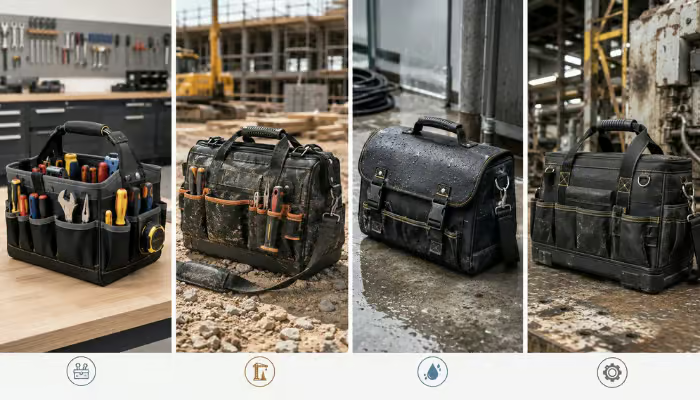
- Indoor workshops and service centers: Tool bags can focus on organization, easy access, and professional appearance without requiring extensive weather protection.
- Outdoor job sites and construction areas: Durable materials such as polyester and nylon help improve abrasion resistance and support frequent handling in demanding environments.
- Wet or humid working conditions: Water-resistant coatings, protective linings, and secure closures help reduce moisture impact on tools and accessories.
- Industrial or high-wear environments: Reinforced fabrics, stronger stitching, and durable hardware support repeated loading, unloading, and daily friction.
Balance Capacity and Carrying Comfort
More storage is not always a better choice because additional space usually increases the overall load. The right balance depends on how much equipment needs to be carried, how often the bag moves, and how long users need to carry it during daily work.
- Short trips between vehicles and job sites: A larger tool tote or backpack can provide more storage space when users only carry the bag for short distances and do not wear it continuously.
- Long hours of continuous carrying: Padded shoulder straps, back support, and balanced weight distribution become more important because discomfort increases during extended use.
- Heavy tool collections carried frequently: A rolling tool bag may be a better solution than a larger backpack when the total load becomes too heavy for regular shoulder or back carrying.
- Changing tool requirements: Flexible compartments and expandable storage options help users adjust the bag layout when different projects require different tool combinations.
Consider Professional, Retail, or Promotional Use
The purpose of the tool bag also affects the right structure, features, and overall design direction. A bag developed for professional users usually focuses on daily performance, while retail and promotional projects may place more attention on appearance, branding, and cost control.
- Professional equipment programs: Focus on durability, practical organization, and long-term use, with features such as reinforced areas, functional compartments, and materials that match demanding work conditions.
- Retail tool bag collections: Consider customer expectations, shelf presentation, size options, and price positioning while maintaining enough functionality for everyday users.
- Promotional and branded projects: Prioritize visible branding areas, controlled production costs, and practical designs that encourage repeated use after distribution.
- Team or company-issued tool bags: Balance functionality and brand consistency by creating a unified design that supports employee needs while representing the company image.
Custom Design Options That Improve Tool Bag Functionality
Custom tool bag design is not limited to changing colors or adding logos. The structure, materials, storage layout, and hardware selection all affect how the bag performs in daily use. A well-planned design can improve tool organization, carrying comfort, durability, and overall user experience.
Size and Capacity Options
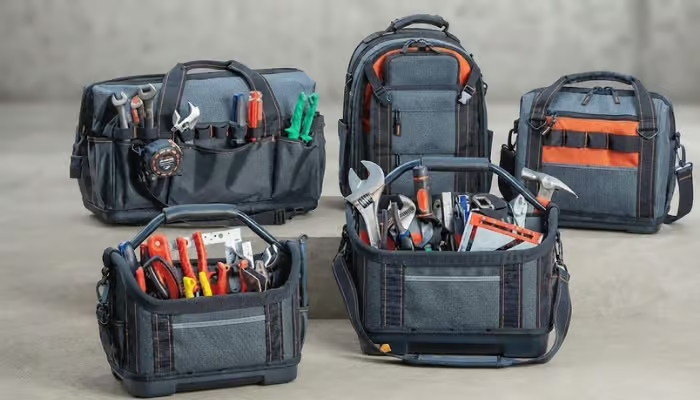
Tool bag size and shape should match the tool types, quantity, and carrying method required for the project. Custom dimensions allow the bag to fit specific tool combinations, while the right capacity helps prevent both overcrowding and unnecessary bulk.
- Compact (around 25 × 15 × 15 cm to 35 × 20 × 20 cm): With approximately 3–8 liters of storage capacity, these sizes fit basic repair kits, personal tool sets, and frequently used hand tools such as screwdrivers, pliers, and measuring tools.
- Medium (about 35 × 20 × 25 cm to 45 × 25 × 30 cm): Offering around 10–25 liters of usable space, this range supports technicians who carry multiple hand tools, accessories, and daily service equipment.
- Large (45 × 25 × 30 cm and above): Providing 25 liters or more of storage capacity, these larger structures accommodate expanded tool collections, power tool accessories, spare parts, and professional equipment.
Internal Organization
Internal organization determines how efficiently users can store, separate, and access different tools inside a custom tool bag. A well-planned interior prevents tools from moving around during transport and helps users maintain a consistent storage layout during daily work.
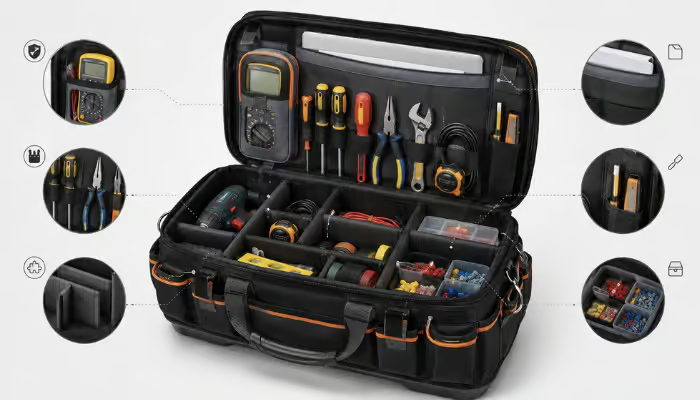
- Fixed compartments: Separate sections keep different tool categories in assigned positions, making it easier to organize hand tools, accessories, and small parts.
- Elastic loops and holders: Flexible straps secure items such as screwdrivers, pliers, measuring tools, and cables while keeping them visible and easy to remove.
- Removable dividers: Adjustable partitions allow users to change the internal layout when tool combinations vary between different projects.
- Specialized storage sections: Dedicated pockets or padded areas can be added for sensitive equipment, electronic devices, documents, or industry-specific tools.
Fabric and Lining Selection
Fabric and lining choices directly affect a tool bag’s durability, protection level, weight, and overall performance in different working conditions. A durable tool bag is not defined by fabric alone; the combination of outer material, lining, reinforcement, and construction method determines long-term performance.
- Outer fabric: Polyester, nylon, canvas, and other durable textiles are commonly used for the main body. Polyester offers practical durability and cost control, while nylon provides stronger tear resistance for demanding applications.
- Inner lining: Polyester lining, soft fabrics, or padded layers help protect tools from direct contact with the outer shell and improve internal organization.
- Bottom panel: Reinforced fabric, PE board, PP board, or molded bases provide additional support in areas that receive frequent impact and heavy loading.
- Padding and protective layers: Foam or cushioning materials can be added around sensitive equipment, measuring devices, or electronic tools to reduce impact during transportation.
- Water-resistant treatments: PU coating, laminated fabrics, or water-resistant finishes help improve protection when the tool bag is exposed to moisture or outdoor conditions.
Reinforced Carrying Structure
Since tool bags often carry metal tools, accessories, and equipment with concentrated weight, handles, straps, and stress points need to support repeated use without losing shape.
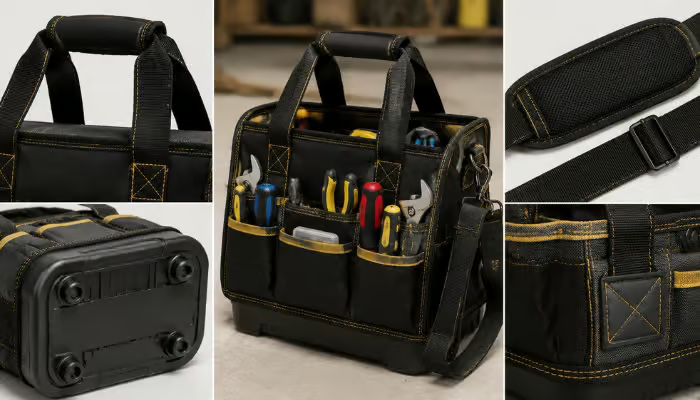
- Handle reinforcement: Wider webbing, cross stitching, and reinforced attachment points help handles support heavier loads during frequent lifting.
- Shoulder strap support: Adjustable straps, padded sections, and stronger connection points improve comfort for tool backpacks and shoulder-carrying designs.
- Bottom reinforcement: PE boards, molded bases, or extra fabric layers maintain stability when the bag is placed on the ground or loaded with heavier tools.
- Corner and stress-point reinforcement: Additional stitching, binding, or protective layers reduce wear in areas that receive repeated pulling and friction.
Closure Systems and Protective Features
A tool bag’s opening and closure design affects how users interact with the bag throughout the day. A frequently accessed repair kit needs a different opening experience from a bag that spends most of its time being transported between locations.
- Full zipper openings: Keep tools enclosed during transportation and provide a cleaner storage solution for mobile service teams.
- Wide-mouth zipper designs: Create a larger opening area, allowing users to load bigger tools and view the contents more easily.
- Flap closure systems: Cover the top opening to add an extra barrier against dust, debris, and accidental tool movement.
- Snap buttons and buckles: Provide quick fastening for external pockets, tool loops, and adjustable storage sections that require repeated access.
- Lockable or reinforced closure points: Add additional security for professional tool kits that need controlled access during storage or transportation.
Branding Elements and User Experience Details
The branding approach should consider both visual impact and daily use, ensuring the logo remains clear while fitting naturally into the overall bag structure.
- Logo placement and application methods: Front panels, side pockets, handles, and shoulder straps provide different branding areas. Screen printing, heat transfer, embroidery, woven labels, and patches can be selected based on the fabric surface, logo complexity, and desired appearance.
- User identification details: Name tags, ID windows, and labeling panels help teams identify tool ownership, equipment categories, or assigned users in professional environments.
- Functional add-ons: Reflective strips, extra pockets, and modular attachments can improve visibility, organization, and convenience for specific applications.
- Color and appearance coordination: Custom colors, contrast details, and finishing choices help maintain consistency with company branding or retail product lines.
Common Mistakes When Choosing Tool Bag Designs
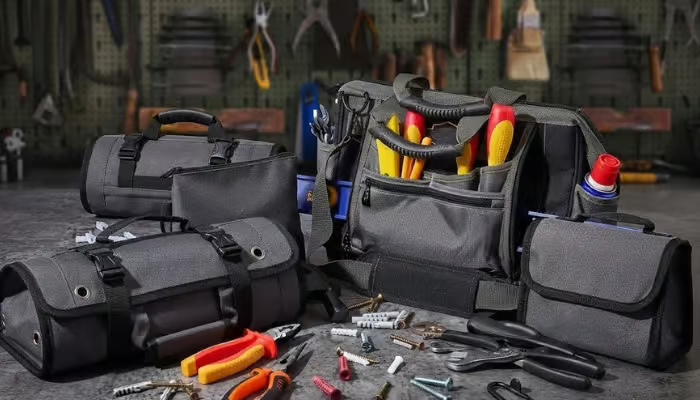
For professional, retail, and custom projects, small design decisions can affect product performance and long-term value. Choosing a tool bag based only on appearance or basic specifications can create problems during actual use. A design that looks attractive in a catalog may not provide the required storage, durability, or comfort when users carry tools every day.
Choosing by Appearance Only
Focusing only on appearance is one of the common mistakes when selecting tool bag designs. Tool bags may look suitable but fail to provide enough storage space, proper tool organization, or sufficient reinforcement for the expected load. Users may experience inconvenient access, poor weight balance, or faster wear after repeated use.
A better approach is to define functional requirements before finalizing the appearance. The structure, capacity, material, and carrying method should match the intended application first, while branding and visual elements can be added after the functional foundation is confirmed.
Ignoring Tool Weight and Load Pressure
Selecting a tool bag without calculating the actual tool load can cause structural problems during daily use. Handles may loosen, seams may split, and the bottom may lose shape when the structure cannot support repeated weight. These issues affect not only durability but also user safety and carrying comfort. Matching the bag structure with the expected load before production or purchase helps prevent these issues.
Adding Too Many Pockets
More compartments do not automatically improve organization. Over-designed pocket systems can reduce the main storage area, increase unnecessary weight, and make frequently used accessories harder to locate. Effective layouts separate tools based on size and usage frequency instead of adding storage sections without a clear purpose.
Using Weak Handles or Thin Bottom Materials
Weak handles or thin bottom materials can cause early damage when tool bags carry heavy loads repeatedly. These areas receive the most pressure during lifting, placing, and transportation, making them more likely to show wear first. Insufficient reinforcement may lead to loose handles, broken stitching, sagging shapes, or reduced stability when the bag is placed on the ground. Choosing stronger materials and reinforcing high-stress areas helps maintain the bag’s structure during regular use.
Overlooking Water Resistance and Cleaning Needs
Ignoring moisture exposure and maintenance requirements can reduce a tool bag’s service life, especially in outdoor, industrial, or frequently used environments. Dust, water, oil, and debris can affect both the outer fabric and the condition of stored tools. Tool bags should match the cleaning and protection needs of the application. Water-resistant fabrics, coated surfaces, wipe-clean linings, and practical opening designs make daily maintenance easier and help the bag remain functional over time.
Skipping Sample Confirmation
Skipping sample confirmation can create unexpected issues during bulk production. A tool bag may meet the basic design description but still have problems with size accuracy, pocket layout, material feel, logo position, or overall usability when produced at scale.
A physical sample allows the structure, loading performance, stitching details, and functional features to be checked before mass production begins. Confirming these details early helps reduce modification costs and prevents large quantities of products from failing to meet the expected requirements.
Maintenance and Care Tips for Longer Tool Bag Use
A tool bag takes a beating over time, but a few consistent habits can extend its usable life well beyond what the stitching alone would suggest. Cleaning, careful storage, and catching small problems early all play a role in keeping a bag functional rather than letting wear accumulate unchecked.
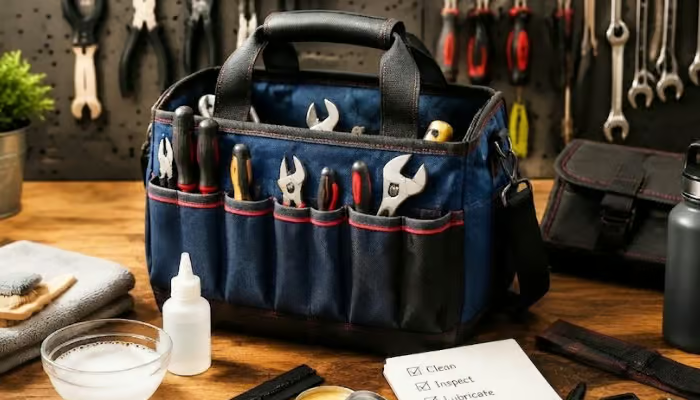
- Keep it clean and dry: Brush or vacuum out dust and metal shavings regularly, spot-clean stains with mild soap and water, and make sure the bag is fully dry before storing it to prevent mold or mildew.
- Take care of zippers and hardware: Clear debris from zipper tracks, apply a little wax or silicone lubricant to keep them sliding smoothly, and avoid forcing an overstuffed zipper shut.
- Avoid overloading: Stay within the bag’s intended weight limit, distribute heavier tools evenly rather than concentrating them in one pocket, and clear out unused items regularly to reduce daily strain.
- Store it properly: Keep the bag upright in a dry location, away from direct sunlight, and loosen the straps between uses to avoid stressing the stitching at the attachment points.
- Handle wear before it spreads: Repair small tears or loose seams early, proactively reinforce high-stress points like handles and straps, and replace worn zippers or buckles rather than retiring the whole bag.
Conclusion
Different types of tool bags are designed around different working needs, from quick-access storage and compact tool organization to heavy-duty transportation and specialized equipment protection. Tool totes, backpacks, rolling tool bags, pouches, belts, bucket bags, and tool rolls each provide different structural advantages for specific applications. Understanding these functional differences helps businesses and users identify the right design direction before moving into customization or product development.
For custom tool bag projects, the final design should combine the right bag type with suitable size, materials, internal organization, reinforcement, closure systems, and branding details. A successful tool bag is not simply a container for tools; it is a functional solution built around how users carry, organize, and access equipment. Contact Gentle Bags to discuss your custom tool bag requirements and develop a solution that matches your target market, application needs, and production goals.
FAQs
1. Which tool bag is best for heavy tools?
Rolling tool bags are often the best choice for heavy tools because wheels and telescopic handles reduce carrying pressure. For smaller heavy tool sets, reinforced totes or backpacks with strong bases and handles can also provide sufficient support.
2. What is the difference between a tool tote and a tool backpack?
Tool totes focus on quick access with an open-top structure, while tool backpacks provide hands-free carrying with better mobility. The choice depends on whether users prioritize fast tool access or easier transportation between locations.
3. What material is best for durable tool bags?
Durable tool bags commonly use polyester, nylon, or canvas depending on the application. The final performance also depends on fabric thickness, reinforcement, lining, stitching, and overall construction.
4. Can tool bags be customized with compartments?
Yes, custom tool bags can include fixed pockets, elastic loops, removable dividers, and specialized compartments based on the tools and workflow requirements. A well-designed layout should improve organization without adding unnecessary storage sections.