
Custom tote bags with a logo can turn a practical everyday item into a visible part of your brand. However, the final result depends on more than just placing artwork on a bag. Fabric texture, logo detail, color, printing area, and the selected branding method can all change the finished appearance.
This guide covers eight ways to customize tote bags with a logo, from screen printing and embroidery to woven labels and patches. You will also learn how materials, tote structures, artwork, logo placement, and bulk-order requirements affect the final result.
Why Use Custom Logo Tote Bags for Brand Promotion?

Custom logo tote bags combine everyday function with repeated offline brand exposure. Unlike one-time promotional materials, a tote bag may continue carrying the logo through shopping, commuting, work, events, and other daily activities long after the original campaign ends.
This repeated use gives tote bags measurable promotional value. According to the Advertising Specialty Institute’s 2026 Ad Impressions Study, a branded tote bag can generate nearly 5,000 impressions over its usable life, making custom tote bags with a logo a cost-effective option for long-term brand exposure.
- Extend campaign visibility: A tote bag can continue circulating after an event, retail promotion, or product launch, which keeps the campaign active beyond its original date.
- Increase logo recognition: Repeated exposure to the same logo, colors, and visual identity can help strengthen familiarity with the brand over time.
- Reach secondary audiences: The bag is seen not only by the recipient but also by people around them in stores, offices, transport hubs, campuses, and public spaces.
- Add practical value to the promotion: Recipients can use the bag for shopping, commuting, work, events, or daily carrying, which gives them a clear reason to keep it.
- Support different marketing programs: The same product format can work for trade shows, membership programs, corporate gifts, retail campaigns, product launches, and branded merchandise.
- Create a stronger physical brand touchpoint: Well-designed tote bags give people something they can see, touch, carry, and reuse, which can make the brand experience more tangible than a digital impression alone.
8 Ways to Customize Tote Bags with a Logo
You can add tote bag logos through several production techniques, from surface printing to stitched or attached branding details. Each method creates a distinct finish, giving brands different ways to present logos, graphics, text, and other visual elements on custom tote bags. The following eight options cover the most practical ways to apply logos to different tote bag designs.
1. Screen Printing

Screen printing transfers ink onto the tote bag through a mesh screen and stencil. Each logo color usually requires a separate screen, so the method works best for simple artwork with solid colors and clear edges.
For tote bags, the fabric panel is usually placed flat on the printing table before assembly, although finished bags can also be printed when their structure allows a stable, even surface. Ink is pressed through the prepared mesh screen onto the fabric, then heat-cured to help the print bond to the material. This process works especially well on cotton, canvas, and many polyester tote bags.
Screen printing provides strong color coverage and consistent results across larger orders, which makes it practical for repeated logo designs. However, additional colors require more screens and setup, while gradients, photographic images, and very fine details are usually less suitable for this process.
2. Heat Transfer Printing

Heat transfer printing uses heat and pressure to apply a pre-printed logo or graphic onto the tote bag surface. The artwork is first produced on transfer film or paper, then transferred to the bag with a heat press, so brands can reproduce multicolor logos, gradients, and detailed graphics without preparing separate screens for each color.
The print area needs to stay flat during pressing so the artwork receives even heat and pressure. This makes heat transfer useful for custom tote bags with a logo that requires more visual detail or smaller production quantities. The main limitation is the added surface layer: large graphics may change the fabric feel, while poor control of temperature, pressure, or pressing time can cause lifting, cracking, or visible press marks.
3. Direct-to-Garment Printing

Direct-to-garment printing, or DTG, sprays water-based ink directly onto the tote bag fabric through a digital printhead. The artwork moves straight from a digital file to the fabric without screens or transfer film, which allows DTG to print gradients, shading, fine lines, and multicolor graphics with strong detail.
The fabric itself has a major influence on the finished print. Cotton and cotton-rich tote bags usually absorb the ink more evenly, while dark-colored bags often require pretreatment and a white ink base before the final colors are printed. DTG gives custom tote bags with a logo a softer print feel and greater freedom for detailed artwork, but it is less economical for very large runs and can give less consistent results on coarse or highly synthetic fabrics.
4. Sublimation Printing

Sublimation printing uses heat to turn special dye into gas, allowing the color to bond directly with polyester fibers instead of forming a layer on the fabric surface. This creates a smooth print with no raised texture, making it suitable for custom tote bags with a logo that uses gradients, photographic images, or large full-color graphics.
This method requires polyester or polyester-rich fabric, and the clearest colors usually appear on white or light-colored tote bags. A lower polyester content can produce a softer or faded result because part of the fabric cannot absorb the dye. Sublimation offers vivid color, fine detail, and strong resistance to peeling or cracking, but it is not suitable for standard cotton, jute, or other natural-fiber tote bags.
5. Embroidery
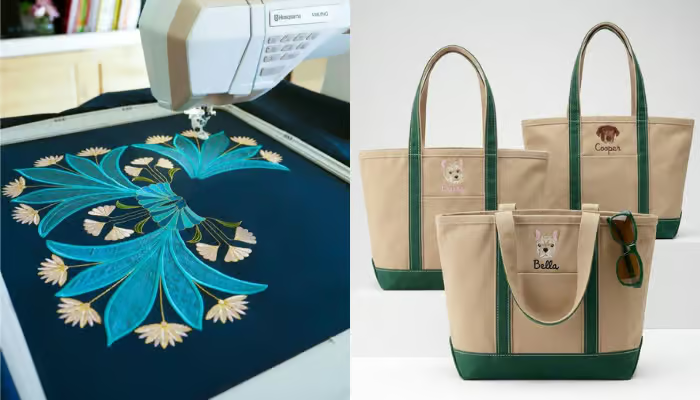
Embroidery builds the logo directly into the tote bag with colored thread, creating a raised and textured finish. A digital embroidery file controls the stitch path, thread colors, density, and sequence before production begins.
Logos with clear shapes, lettering, and limited color changes usually work best. Canvas, cotton, denim, and other fabrics with enough body can support the stitching more easily, while thinner materials may need backing to prevent puckering or distortion.
Embroidery gives custom tote bags with a logo a durable finish that holds up well against fading and surface wear. Dense stitching can increase cost and stiffen the fabric, while very small text, gradients, and highly detailed graphics often need to be simplified before production.
6. Laser Engraving

Laser engraving directs a focused beam onto the tote bag surface to remove or darken a thin material layer, forming the logo without ink, thread, or transfer film. The finished mark becomes part of the surface and often creates a subtle, tone-on-tone branding effect rather than a bright printed graphic.
Leather totes, selected PU materials, denim bags, cork, and certain coated fabrics can accommodate laser engraving. Power, speed, and focus need to match the material closely because excessive heat may scorch the surface, damage fibers, or produce uneven logo edges.
Laser engraving creates a durable logo with no added surface layer, so there is nothing to crack or peel away. Its main limitations are restricted color options and narrower material compatibility. PVC tote bags should not be laser engraved because heating PVC can release hazardous chlorine-containing fumes.
7. Woven Labels

Woven labels form the logo by weaving colored yarns into a small fabric label, which is then sewn onto the tote bag. Instead of printing directly on the bag surface, this method adds a separate branding element around the side seam, pocket, opening, or interior.
Compact brand names, symbols, and simple logos usually work well in woven form. Brands often choose this option for secondary identification when the front panel already carries a larger printed or embroidered graphic, or when they want a subtle textile detail rather than a dominant logo.
The woven structure keeps colors and edges consistent across repeated orders and withstands regular handling well. However, the limited label size restricts very small text, gradients, and complex artwork, so the logo may need simplification before production.
8. Custom Patches

Patches can create a distinctive, dimensional logo and work well for branding that needs a stronger visual identity. Custom patches create the logo as a separate decorative piece that is attached to the tote bag by sewing or heat application. Embroidered, woven, rubber, leather, and printed patches can all produce different textures and visual effects, which makes patches more flexible than a single surface-printing method.
A patch can sit on the front panel, pocket, side panel, or near the opening, depending on the bag structure. Because the branding element is made separately, it can add depth and contrast even when the base fabric has a coarse texture or uneven surface. However, they add material and attachment steps to production, and oversized or heavy patches may affect the drape of lightweight tote bags.
Compare Logo Customization Methods for Tote Bags
Different logo customization methods create very different results on tote bags because the fabric surface, bag structure, branding area, and expected use all affect the finished logo. The table below compares these methods across durability, visual effect, design complexity, and order requirements specifically for custom tote bags.
| Method | Durability | Visual Effect | Design Complexity | Order Requirements |
| Screen Printing | High with correct ink and curing | Bold, flat, solid-color finish | Best for simple to medium-detail artwork | More economical for repeated designs and larger runs |
| Heat Transfer Printing | Medium to high | Smooth or slightly raised full-color surface | Handles gradients, fine details, and multicolor graphics | Practical for smaller runs or designs with many colors |
| DTG Printing | Good on suitable cotton-rich fabrics | Soft, detailed print appearance | Strong for complex artwork and tonal details | Better suited to lower-volume, design-heavy orders |
| Sublimation Printing | Very high on polyester | Bright color with no surface layer | Supports photographs, gradients, and large graphics | Requires polyester-based fabric and light base colors |
| Embroidery | Very high | Raised, textured, dimensional finish | Better for simplified logos and lettering | Stitch count, size, and thread colors affect cost |
| Laser Engraving | High on compatible materials | Subtle, tonal, understated mark | Better for simple logos and line graphics | Material testing is important before bulk production |
| Woven Labels | High | Clean textile detail | Suitable for compact logos with controlled detail | Requires separate label production and sewing |
| Custom Patches | High with secure attachment | Raised, dimensional, high-contrast finish | Good for emblem-style logos and layered designs | Requires separate patch production and attachment |
How to Plan Logo Customization for Tote Bags?
Planning logo customization starts before the artwork reaches production. The branding purpose, tote bag material, bag structure, logo size, placement, and artwork format all shape what can be produced successfully. Defining these elements early helps keep the logo visually balanced while avoiding unnecessary revisions during sampling.

Define the Branding Purpose
Before developing the tote bag design, define the main branding purpose first. The intended use directly affects the bag quality, logo visibility, design style, material choice, and budget. A tote bag made for a one-day trade show should not follow the same development priorities as a retail tote that customers will pay to own.
- Promotional Giveaways: Trade shows, conferences, and large promotional event totes usually require higher quantities and tighter unit-cost control. The logo should stay easy to recognize from a distance, while supporting information such as a website, slogan, or campaign message can strengthen the promotional function.
- Staff Gifts: Tote bags for onboarding kits, employee programs, or internal gifts need more attention to everyday usability and perceived quality. A restrained logo, heavier fabric, practical pockets, or a more refined branding technique can make the bag feel less like a giveaway and more like a useful company item.
- Retail & Merchandise: When custom tote bags with a logo are sold as merchandise, the bag itself becomes part of the product offering rather than only a branding carrier. Material feel, construction, color combinations, logo treatment, and overall design need enough distinction to support the selling price and encourage customers to carry the bag regularly.
Match the Logo Method to the Tote Bag Material

Different tote bag fabrics respond differently to printing, stitching, heat, and other branding processes. Fiber content, surface texture, fabric weight, and heat sensitivity all influence which logo method can achieve a clear and stable result.
- Cotton Bags: Work with screen printing, DTG, heat transfer, and embroidery. Smoother fabrics keep printed details clearer.
- Canvas Bags: Pair especially well with screen printing, embroidery, woven labels, and custom patches. Their heavier structure gives logos more visual weight, although coarse canvas can soften very fine printed lines.
- Polyester and RPET Bags: Suitable for sublimation, heat transfer, and selected screen-printing systems. Light-colored polyester totes can carry full-color sublimation well, while coated or textured versions may require process testing first.
- Denim Totes: Work naturally with embroidery, patches, screen printing, and selected laser treatments. Its dense construction supports dimensional branding without the panel losing shape easily.
- Jute Tote Bags: Better for bold screen printing, woven labels, and patches. Fine graphics can lose clarity on the coarse weave.
- PU Leather Bags: Can take laser marking, patches, metal logos, and selected transfer methods. Surface testing is important before production.
Select the Right Tote Bag Style
Tote bag structure changes the shape, capacity, and proportion of the main branding panel. A flat tote provides a broad uninterrupted surface, while bottom or side gussets create a fuller profile that changes how the front panel appears when the bag is filled. Selecting the structure first gives you a more realistic basis for planning the logo scale and overall visual balance.
- No Gusset: A flat structure with the largest visible front panel. Large centered logos and full-panel graphics work especially well on this format.
- Bottom Gusset Only: Adds capacity while keeping the front profile relatively flat. Prominent front branding still has plenty of room to stand out.
- Side Gussets Only: Creates more volume and a slightly more structured shape. Extra carrying space comes without greatly reducing the main front branding area.
- Side and Bottom Gussets: Provide the most depth and a fuller three-dimensional profile. Retail, corporate, and premium gift totes often use this structure when capacity and product presence matter alongside branding.
Plan the Logo Size and Placement

Logo size and placement should match the visible area and visual balance of the tote bag rather than simply using the largest space available. A logo that is too small can lose impact on a broad panel, while oversized artwork can feel crowded or extend too close to folds and seams. The bag structure, intended viewing distance, and whether the logo acts as the main graphic or a secondary brand mark should all influence the final layout.
- Centered Front: Best for primary logos, campaign graphics, and designs that need strong visibility.
- Upper Front: Creates a cleaner, more restrained look while leaving more open space on the bag.
- Pocket Branding: Uses the pocket as a defined logo area and separates the branding from the main panel.
- Side Placement: Works well for smaller logos or secondary brand marks.
- Dual-Side Branding: Allows different graphics or messages on the front and back while keeping the overall design consistent.
Prepare the Logo Artwork
Prepare the logo file according to the selected customization method and final production size. Vector formats such as AI, EPS, or PDF work well for most logo applications, while raster artwork needs sufficient resolution for digital printing. Clear dimensions, color references, and simplified details also help keep the finished logo consistent with the approved design.
- Set the final dimensions: Prepare the logo at the actual production size rather than relying only on proportional scaling.
- Confirm the color system: Define Pantone references, CMYK values, or thread colors when brand consistency matters.
- Simplify fine details: Very thin lines, tiny text, tight spacing, and complex gradients may need adjustment for certain logo methods.
- Outline fonts: Convert text to outlines so missing fonts do not change the logo during prepress.
- Separate artwork versions: Create different files when the front, back, pocket, or patch requires a different logo size or layout.
Common Mistakes When Customizing Tote Bags with a Logo
Even an approved logo design can develop problems during bulk production if key details are not controlled carefully. The following mistakes often affect consistency, appearance, and the final branding result across custom tote bag orders.

Overlooking Logo Consistency Across the Order
Logo consistency does not mean using the same artwork file on every tote bag variation. Mixed orders may include light and dark fabrics, different tote sizes, or several bag structures, and one logo version may not remain equally visible or balanced across all of them.
A dark logo that looks clear on cream canvas can disappear on black fabric, while artwork scaled down for a smaller tote may lose legibility. Prepare separate logo versions for different bag colors and sizes, while keeping the core proportions, typography, and brand elements consistent across the full order.
Ignoring Fabric Color Variation
A logo color will not always appear the same across different tote bag fabrics, even when the artwork and ink specification stay unchanged. Natural canvas may carry a warm cream tone that shifts transparent or lighter inks, while dyed fabrics can reduce contrast or alter the perceived color of the finished logo.
The risk becomes greater on dark or strongly dyed materials. On some polyester-based fabrics, heat can trigger dye migration, causing the fabric dye to contaminate lighter printed colors. For these projects, a suitable white underbase or dye-blocking ink system may be needed before the final colors are applied. Always evaluate the logo against the actual fabric color rather than approving it from the digital artwork alone.
Combining Incompatible Branding Techniques
Using more than one branding method can add depth to a tote bag, but the techniques still need to work together visually and physically. A large heat-transfer graphic placed too close to dense embroidery, for example, can create uneven stiffness across the panel, while a heavy patch may distort a lightweight fabric or compete with the main printed logo.
Keep each branding element in a clearly defined role. Use one method for the primary logo and another for secondary details only when the material, spacing, and overall design can support both. This prevents the tote bag from looking overdecorated and reduces production problems caused by overlapping heat, stitching, or attachment areas.
Forgetting Packaging Effects on the Logo
Packaging can change a finished logo’s appearance after production, especially when tote bags are tightly folded, stacked, or compressed for shipment. Large heat transfers may show crease marks, raised embroidery may press against adjacent bags, and printed surfaces may scuff during packing or transport.
Match the packing method to the branding finish. Position fold lines away from major logo areas where possible, allow printed surfaces to cure completely, and add tissue or individual sleeves for finishes that are sensitive to abrasion or pressure.
Losing Control of Approved Specifications
Approved logo specifications can easily drift when changes are made after sampling or when repeat orders rely on memory instead of documented production files. A small adjustment to logo size, thread color, print position, or tote bag material may seem minor, but it can create visible differences between batches.
Keep one final approval record that includes the artwork file, logo dimensions, color references, placement, bag material, and branding method. For repeat orders, compare the new production setup against the last approved version before manufacturing starts, rather than assuming the previous specifications will be copied automatically.
What Should You Specify When Ordering Custom Logo Tote Bags?

A complete specification sheet gives the supplier enough information to quote, sample, and produce the tote bag accurately. Record the bag structure, material, dimensions, logo requirements, quantity breakdown, packaging, and delivery needs in one document. Material choice, branding complexity, and order quantity will also shape the final quotation.
- Bag Structure: Specify whether the tote is flat, bottom-gusseted, side-gusseted, or fully gusseted, together with any pockets, lining, or reinforcement.
- Material: Confirm the fabric type, weight, color, finish, and any recycled-content requirements. Material choice often creates one of the largest differences in the base bag cost.
- Dimensions: Provide the finished width, height, gusset depth, handle length, and other dimensions that affect the final construction.
- Logo Details: State the branding method, logo size, placement, color references, and artwork file. Multiple positions, extra print colors, or high embroidery stitch counts may increase decoration cost.
- Order Breakdown: List the total quantity and any split by bag color, size, or logo version. Larger quantities usually spread setup costs across more units, while many variations add production complexity.
- Packaging: Define the folding method, individual packing, protective materials, carton requirements, or retail-ready packaging.
- Delivery Requirements: Include the destination, required delivery date, and preferred shipping method so production and logistics can be planned together.
Why Choose Gentle Bags for Custom Tote Bags with a Logo?
Gentle Bags supports custom tote bag projects from material selection and structural development to logo application, sampling, bulk production, inspection, and shipment coordination. With an MOQ of 500 pieces, samples in 3–7 days, and typical production lead times of 15–25 days, we can support retail, corporate, promotional, and private-label programs with coordinated control over both the bag and the branding details.
You can customize the material, size, gusset structure, handles, pockets, lining, colors, and logo method around your intended application. Contact us with your artwork, reference sample, target quantity, or initial concept, and our team can help turn it into a production-ready custom tote bag specification.
Conclusion
A successful tote bag logo depends on the relationship between the branding method, material, bag structure, and artwork not on the decoration technique alone. The right combination keeps the logo clear, visually balanced, and suitable for the way the finished tote will actually be used.
For bulk custom tote bags with a logo, define the key specifications before sampling and treat the approved sample as the production reference. This gives you better control over branding consistency, material performance, and the final appearance across the complete order.
FAQs
1. What Is the Best Method for Putting a Logo on a Tote Bag?
There is no single best logo method for every tote bag. Screen printing works well for bold graphics and larger runs, while DTG or heat transfer suits detailed full-color artwork. Embroidery, woven labels, and patches fit projects that need more texture, while sublimation is limited to polyester-based fabrics.
2. Can You Print a Full-Color Logo on a Tote Bag?
Yes. Full-color logos can be applied to tote bags through DTG, heat transfer, or sublimation, depending on the fabric. DTG suits many cotton-rich bags, heat transfer works across a wider range of materials, and sublimation is mainly used on white or light-colored polyester fabrics.
3. Can You Print a Logo on Both Sides of a Tote Bag?
Yes, both the front and back of a tote bag can carry printed logos or graphics when the structure provides suitable branding areas. You can repeat the same logo on both sides or use different artwork for each panel. Account for the final print size and placement, seams, gussets, pockets, and reinforcement.
4. What File Format Is Best for a Tote Bag Logo?
Vector formats such as AI, EPS, or vector PDF are usually the best choice for tote bag logo customization. They allow the artwork to be resized without losing edge quality and work well for screen printing, embroidery digitizing, woven labels, and patches. High-resolution raster files may also work for DTG, heat transfer, or sublimation.