
School bags come in many forms, and each type serves a different mix of carrying, storage, comfort, and daily-use needs. For brands and wholesale buyers, choosing among the common types of school bags requires more than comparing appearance. Bag structure, student age, load, use environment, and target price all affect the final product direction.
This guide explains the main school bag styles, their typical uses, materials, selection factors, customization options, and common sourcing mistakes. It will help you compare school bag types more clearly and define a product that fits your target market.
What Is a School Bag?

A school bag is an everyday school essential made to carry books, stationery, and other items students need for classes and daily activities. Its purpose goes beyond simple storage. The bag needs to support frequent carrying, repeated opening and closing, and regular movement between home, transport, classrooms, and other school areas.
The term “school bag” refers to the overall product category rather than one fixed design. Different school bags can use different carrying structures, shapes, and layouts, but they all serve the same basic role: keeping school-related items organized and practical to carry during everyday use.
What Are the Main Types of School Bags by Style?
School bags come in several styles, and each style uses a different structure to carry and organize school essentials. The shape of the bag and the way students carry it influence how well it handles books, notebooks, and other daily items. Understanding these structural differences makes it easier to distinguish one school bag style from another.
Backpacks

School backpacks feature a vertical body and two shoulder straps, creating a structure that keeps books and other classroom items close to the back. Their main compartment is usually shaped around rectangular contents, so textbooks, notebooks, and folders can sit upright rather than spreading across the width of the bag. A broad zipper opening also gives enough clearance for these rigid items to move in and out easily.
Compared with a lightweight casual backpack, a school version normally has a more defined base and back area. This helps the body stay upright when books settle at the bottom and prevents the contents from pushing the rear panel out of shape. The result is a compact school bag structure that keeps the load close to the student’s back instead of letting it hang away from the body.
Rolling Bags

A rolling school bag builds the storage body around a wheel set, reinforced base, and retractable pull handle. These components change both the exterior shape and the usable interior because the handle tubes and wheel housings occupy fixed space along the rear and lower sections of the bag.
Books often create concentrated weight near the bottom, so this lower section needs to remain aligned with the wheels when the bag is pulled. Many designs also include a top handle or shoulder straps for lifting over steps, which means the same school bag body must stay stable in both upright and carried positions. This makes rolling bags structurally different from standard backpacks, even when their outer shape looks similar.
Messenger Bags

Messenger school bags typically have a horizontal or rectangular body, one long adjustable strap, and a wide flap that covers most of the front opening. The strap connects to both sides of the bag and usually supports crossbody carrying, while the flap can work with a zipper, buckle, magnetic closure, or hook-and-loop fastening underneath. This creates a flatter profile than most school backpacks.
With a wide and shallow body, this style accommodates flat school materials across the main compartment instead of stacking them deeply. Front pockets often sit under or on the flap for smaller supplies, while the limited depth keeps the loaded bag closer to the body. These structural details distinguish a school messenger bag from a general shoulder bag.
Shoulder Bags

Shoulder school bags place the main compartment below a single shoulder strap and allow more variation in body shape than messenger designs. They may use a vertical, square, or compact rectangular form, but the strap connection remains the main structural point supporting the loaded bag.
Since the full school load hangs from one side, the body usually needs controlled depth and a relatively compact profile. A wide lower section can pull the bag outward once books and supplies are added, while poorly positioned strap anchors can make the body tilt. School shoulder bags therefore rely on proportion and strap placement to keep the structure balanced rather than on a broad back panel.
Tote Bags
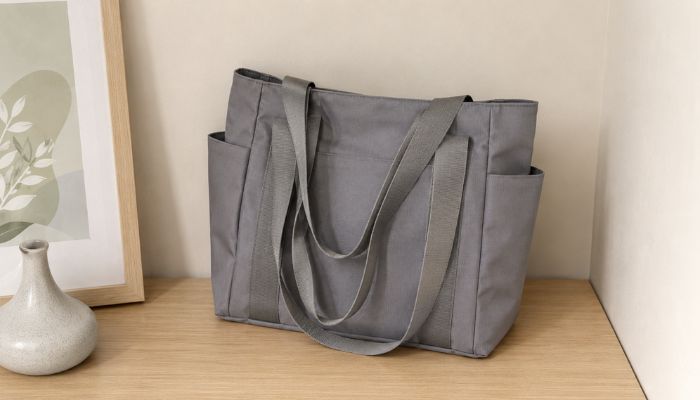
School totes have two parallel handles and a broad top opening around a simple, open main compartment. Their straight body lines make it easy to place wide school materials vertically into the bag, with fewer structural barriers around the opening.
For school use, a tote usually needs a more stable bottom than a thin shopping tote because books place concentrated pressure on the base and handle joints. A defined bottom panel also helps the tote keep its rectangular profile after loading. Compared with more divided school bag styles, the tote structure depends on one accessible storage area rather than multiple fixed sections.
Drawstring Bags

Drawstring school bags use a soft body with cords that both close the opening and form the shoulder straps. The upper edge gathers when the cords are pulled, so the bag does not need a rigid zipper opening, flap, or framed top section.
Because the body has very little fixed structure, books, sports clothing, or small school items largely determine its final shape once placed inside. The flexible body also folds flat when empty. Structurally, a drawstring school bag represents the simplest option in the category because the closure and carrying system work as one continuous element.
Convertible Bags

Convertible school bags center on one storage body that supports more than one carrying configuration. The structure may include hidden backpack straps, detachable shoulder straps, grab handles, or adjustable attachment points that allow the same bag to change its carrying position.
In each carrying mode, the school bag body still needs to remain stable and easy to access. Strap storage areas cannot interfere with the main opening, and attachment points need to sit where they do not twist the loaded body. A practical convertible structure keeps the school compartment consistent while allowing the carrying system to change around it.
School Bag Types Comparison Table
The main school bag styles differ not only in appearance but also in the way they carry weight, handle everyday contents, and fit different school routines. A quick comparison of their carrying methods, typical structure, suitable use, and main limitation makes these differences easier to see at a glance.
| School bag type | Main carrying method | Typical structure | Best suited to | Main limitation |
| Backpack | Two shoulder straps | Structured or semi-structured | Regular daily school use | It can become bulky at larger capacities |
| Rolling bag | Wheels and pull handle | Reinforced base | Heavier loads | Less convenient on stairs |
| Messenger bag | Crossbody or one shoulder | Flat, horizontal body | Books, folders, moderate loads | Uneven weight distribution |
| Shoulder bag | One shoulder strap | Compact or soft body | Lighter school loads | Limited comfort with heavy contents |
| Tote bag | Two handles | Open or zippered main body | Large flat items and quick access | Limited hands-free carrying |
| Drawstring bag | Cord shoulder straps | Soft, flexible body | Lightweight essentials | Minimal structural support |
| Convertible bag | Multiple carrying methods | Adjustable structure | Flexible product programs | More complex hardware and construction |
What Features Do School Bags Need for Different Uses?
The right school bag features depend on what students carry, how often they access those items, and what happens during each school activity. A practical design should solve the main storage or protection problem of that specific situation rather than add as many pockets and accessories as possible.
Daily Classroom Use

For everyday lessons, a school backpack needs to keep frequently used supplies organized and easy to reach throughout the day. Its stable main storage area supports repeated packing and access between classes, while the familiar backpack format keeps daily school items in a clear and practical arrangement.
- Main Storage Area: Provides enough unobstructed space for textbooks, notebooks, and folders while keeping them upright and easy to remove.
- Small-Item Organization: Separate pockets prevent pens, keys, cards, and other loose items from disappearing underneath larger contents.
- External Bottle Storage: Keeps a water bottle away from books and paper materials and makes it accessible during the school day.
- Practical Access: A wide opening and clearly positioned pockets reduce the need to empty the bag when students need one specific item.
Laptop and Device Carry

When laptops or tablets become part of the school load, protection and controlled storage take priority over open space alone. A messenger-style laptop bag can provide a flatter profile with a defined device section, keeping the laptop or tablet close to the wearer and separated from harder contents inside the main storage area.
- Padded Device Compartment: Separates the laptop or tablet from books and reduces direct impact against the back or outer panels.
- Raised or Cushioned Base: Adds protection where devices face the greatest impact when students place the bag on a desk or floor.
- Accessory Pockets: Keep chargers, cables, adapters, and mice from pressing against the device or becoming tangled with school supplies.
- Separate Device Access: Allows students to remove electronics without taking books and other classroom materials out of the main compartment.
PE and Sports Activities

PE and sports bags need to manage clean school supplies alongside shoes, used sportswear, towels, and water bottles. A lightweight drawstring bag often works as a simple secondary PE option, while more structured designs, such as duffel bags, rely on separation and ventilation to control moisture, dirt, and odor around other school contents.
- Separate Shoe Compartment: Keeps footwear away from notebooks, clothing, and other clean contents.
- Ventilated Storage: Mesh panels, eyelets, or other ventilation details allow air to move through areas that hold sports shoes or clothing.
- Wet and Dry Separation: An isolated section helps contain damp towels, swimwear, or sportswear after activity.
- Easy-Clean Interior: Wipeable surfaces in sports-specific areas make dirt and moisture easier to remove after repeated PE sessions.
Art and Project Work

Art and project work often require more usable width and flatter storage than standard classroom activities. Tote bags fit this need well through a broad opening and open interior that make drawing pads and project sheets easier to load and remove.
- Wide Main Opening: Gives larger sketchbooks, folders, and project materials enough clearance during loading and removal.
- Flat Storage Section: Helps keep drawings, worksheets, and presentation materials from folding around smaller objects.
- Larger-Format Space: Provides room for materials that extend beyond standard notebook dimensions.
- Tool Organization: Dedicated pockets or elastic holders keep brushes, pens, rulers, scissors, and similar supplies away from finished work.
Field Trips

During field trips, students usually need lightweight storage, secure closures, and quick access while moving between locations. A compact backpack suits this setting well, keeping both hands free and giving students convenient access to personal items during walking, transport, and group activities.
- Quick-Access Pockets: Keep tickets, cards, tissues, or other frequently handled items separate from the main contents.
- Secure Closures: Zippers or other controlled openings reduce the chance of items falling out while students walk, board transport, or move between activity areas.
- Accessible Bottle Storage: Allows students to reach water without repeatedly opening the main compartment.
- Basic Weather Protection: A water-resistant outer surface or protected zipper area helps limit moisture exposure during light rain or outdoor activities.
Common Materials Used for School Bags
School bags are made from a range of materials, and each one brings a different balance of weight, structure, surface feel, durability, and cost. These differences influence the finished bag’s appearance, handling, and suitability for daily school use. Understanding the basic characteristics of each material makes it easier to select a fabric that fits the intended school bag style and product requirements.
Polyester

Polyester is one of the most widely used materials for school bags because it provides good abrasion resistance, low moisture absorption, stable dimensions, and flexible cost control. Polyester bags also remain relatively lightweight and easy to maintain during daily use. Lighter polyester grades can be more vulnerable to punctures and tearing once the yarn structure is damaged, especially around areas exposed to concentrated pulling or sharp objects.
- 300D–420D polyester: Suits lighter school bags, secondary panels, and areas where lower empty weight matters.
- 600D polyester: A common choice for main panels because it provides useful body and everyday abrasion resistance at a controlled material cost.
- 900D–1200D polyester: Fits heavier school bag constructions or high-wear sections that need a denser fabric.
Nylon

Nylon school bags offer a good balance of tear resistance, flexibility, and relatively low fabric weight. The material bends well around zipper openings, side panels, and strap areas, which helps the bag stay flexible during repeated daily use instead of feeling overly rigid.
Lighter options such as 210D nylon are often used for linings or secondary panels, while 420D and 500D grades suit exterior sections that need more strength. Heavier specifications such as 1000D nylon fit reinforced areas exposed to greater wear. Nylon usually costs more than standard polyester, making the final grade an important part of balancing durability needs with the target product position.
Oxford Fabric

Oxford school bags have a firm woven structure that gives the bag more body and helps the panels stay neat when loaded with books and notebooks. The fabric also works well for designs that need a more defined shape rather than a soft, slouchy appearance.
Lighter specifications such as 300D and 420D Oxford suit school bags that need less bulk, while 600D Oxford gives the main body more structure and better resistance to repeated surface wear. As the fabric becomes heavier, the bag usually gains more body but also more empty weight, so the specification should match the intended school bag size and load.
Canvas

Canvas school bags stand out for their dense weave, firm hand feel, and textured surface, giving the finished product a more substantial and natural appearance. The fabric holds shape well, tolerates repeated surface friction, and develops a softer feel over time. Compared with many synthetic fabrics, canvas is generally heavier and absorbs moisture more readily.
Fabric weight affects both structure and overall bag weight. 8–10 oz canvas suits lighter school bag designs, while 10–12 oz provides more body for a firmer shape. 12 oz and above create a heavier, more rigid construction and fit designs that intentionally call for a more substantial feel.
PU Leather

PU leather school bags typically have a smooth surface, even color, and a cleaner visual finish than most woven fabrics. The material works well with embossed textures, printed patterns, and structured panel designs, which makes it suitable for school bags that need a more polished exterior. Its non-absorbent surface is also easier to wipe clean after daily contact with desks, floors, or outdoor surfaces.
Repeated bending and abrasion are the main concerns. Corners, folded edges, handle bases, and zipper areas can crack or peel sooner if the PU layer is too thin or the backing lacks support. For school bags with large PU leather panels, thickness, backing strength, flex resistance, and surface durability should be checked together rather than judging the material by appearance alone.
RPET Fabrics

RPET fabric is made from recycled PET, often sourced from post-consumer plastic bottles, and is widely used in school bag collections that require recycled-content specifications. It can be produced in different weights and constructions for outer panels, pockets, and linings while maintaining the practical durability and relatively low weight associated with polyester fabrics.
Material consistency can vary with the recycled feedstock, yarn quality, and processing method, so color, surface appearance, and hand feel may need closer control across repeat orders. For RPET bag programs that require verified recycled claims, GRS and RCS can verify recycled content and chain of custody, while certified materials may also add sourcing and documentation costs.
What Should You Consider When Choosing a School Bag Type?
The right school bag type should match the student group, expected load, use environment, durability level, and target cost. These factors affect more than the appearance of the finished bag. They determine whether the size, carrying structure, storage capacity, and construction remain practical for the intended market.

Target Age Group and Carrying Comfort
School bag requirements change as students grow, especially in body size, carrying strength, and daily load. Different age groups require different bag proportions and levels of carrying support. The American Academy of Pediatrics recommends backpacks that fit a child’s size and include broad, adjustable shoulder straps and a padded back, offering a useful reference for school bag fit and carrying comfort.
- Preschool and Kindergarten (3–5 years): Small body proportions call for a light bag, short strap range, and simple carrying support that does not overwhelm the child.
- Elementary School Students (6–11 years): Daily book carrying requires padded straps, stable back contact, and a bag size that stays proportional to the child’s frame.
- Middle and High School Students (12–17 years): Heavier academic loads make strap width, back support, and load position more important for daily comfort.
- College and University Students (18+ years): Longer commuting and device carry place more emphasis on stable support, flexible adjustment, and comfort over extended periods.
Capacity and Storage Requirements
School bag capacity should match the amount of school gear students normally carry, with most everyday designs falling roughly between 10 and 30 liters. Smaller capacities suit lighter daily loads, while larger sizes provide more room for students who need to carry more materials throughout the school day. The key is to leave enough usable space without making the bag unnecessarily bulky.
| Typical Capacity | Suitable Load Level | Storage Requirements |
| 10–15 L | Light daily load | Small books, stationery, snack box, bottle |
| 15–20 L | Standard classroom use | A4 notebooks, folders, pencil case, bottle |
| 20–25 L | Larger academic load | Textbooks, A4 folders, lunch box, small device |
| 25–30 L | Books plus devices and personal items | Larger textbooks, laptop/tablet, lunch, accessories |
| 30 L+ | High-volume school programs | Multiple books, sportswear, devices, and additional gear |
Environment and Safety Needs
The school environment can affect which protective and safety details a school bag needs. Weather exposure, traffic conditions, commuting methods, and crowded public spaces all create different requirements, so the design should reflect where and how students actually use the bag.
- Rain and Wet Conditions: Water-resistant surfaces and protected openings reduce moisture exposure during light rain.
- Low-Light Travel: NHTSA guidance notes that retroreflective materials improve nighttime visibility. Reflective strips or high-visibility details on school bags can therefore make students easier to notice when walking or cycling in darker conditions.
- Crowded Commuting: Secure zipper closures and controlled pocket openings keep personal items contained on buses, trains, or busy school routes.
- Outdoor Exposure: Reinforced exterior areas and easy-clean surfaces help the school bag handle contact with playgrounds, pavement, and other outdoor surfaces.
Construction and Durability
School bags need a construction that spreads the load through the whole body instead of concentrating stress at a few connection points. Panel layout, seam placement, base support, zipper installation, and strap attachment all affect structural stability, especially when the bag carries heavier contents or has a deeper body.
Durability shows whether that structure can keep working after repeated daily use. Over time, the school bag should retain its shape, closures should keep operating smoothly, seams should stay intact, and carrying points should remain secure. The required durability level depends on the expected load and use frequency, not simply on heavier fabric or added layers.
Target Cost and Budget
Target cost affects which school bag type and specification level can realistically fit the intended market position. A simple construction usually requires fewer panels, components, and sewing steps, while designs with wheels, convertible carrying systems, heavy padding, or multiple functional sections increase material use and assembly time. These differences can create a noticeable cost gap even when the bags have similar exterior dimensions.
The budget should cover the features that define the product first, then control secondary details that add cost but contribute less to its main purpose. Fabric grade, hardware level, lining, padding, and structural complexity all influence the final unit cost. A practical school bag specification balances the required function, expected durability, and target price instead of pushing every component toward either the lowest or highest grade.
Customization Options for Different School Bag Types
School bag customization should turn a defined product concept into clear production specifications. Once the bag type and target use are confirmed, dimensions, compartments, branding, carrying details, and packaging can be adjusted to create a consistent product for a specific market or school program.
Custom Dimensions and Capacity

School bag dimensions can vary in width, height, depth, and overall volume to fit a specific product brief. These measurements work together, so a change in one dimension can affect the bag’sbag proportion, usable space, and finished appearance. The same design can also use several size versions for different SKUs or student groups.
- Width: Controls the front profile and the amount of horizontal storage space.
- Height: Sets the vertical proportion of the school bag and affects the size of the main body.
- Depth or Gusset: Changes the internal volume and determines how far the bag projects outward when filled.
- Target Capacity: Defines the intended usable volume while keeping the overall dimensions within the required product range.
Compartment Configuration
Compartment configuration defines the way storage space is divided within a school bag. The layout can vary in compartment count, space proportion, and opening position, allowing the storage structure to follow the intended bag design without adding unnecessary pockets or complexity.
- Compartment Count: Set one, two, or multiple main storage sections according to the product structure.
- Space Proportion: Adjust the depth and volume allocated to each compartment.
- Divider Structure: Choose fixed, padded, mesh, or removable dividers for different levels of separation.
- Pocket Placement: Add pockets to the front panel, side panels, interior walls, back panel, shoulder straps, or inside the main compartment, with the size and opening style adjusted to the intended contents.
- Access Configuration: Use top, front, side, or dual openings to change how each storage area is reached.
Logo and Branding
Logo and branding options vary with the school bag material, artwork style, and desired visual effect. The selected decoration method needs to suit the fabric surface and artwork complexity, while the placement should stay clear of seams, zippers, and strongly curved areas that may affect the finished result.
- Screen Printing: Suits simple logos, bold graphics, and limited-color designs on relatively flat fabric panels.
- Embroidery: Creates a stitched, textured finish on fabrics with enough stability to support the thread density.
- Heat Transfer: Handles detailed and multi-color artwork, but the temperature and pressure need to suit the selected school bag material.
- Sublimation Printing: Works mainly with polyester-based fabrics and is suitable for full-color graphics, gradients, and larger printed areas.
- Digital Printing: Supports detailed artwork and complex color designs, with the final result depending on the fabric type, surface treatment, and printing system.
- Woven or Rubber Patches: Add a separate branded element with a more dimensional finish for front panels, pockets, or other visible areas.
Carrying System and Trim Details
Carrying system and trim details influence both the handling and the finished look of a school bag. Adjustments to these components refine the carrying experience and create a more consistent product style while keeping the main bag structure unchanged.
- Shoulder Straps: Adjust width, padding thickness, length, and attachment style to suit the selected school bag design.
- Handles: Add top, side, or reinforced grab handles according to the required carrying setup.
- Webbing: Specify width, thickness, weave, and color for straps, loops, and attachment areas.
- Zippers and Pullers: Select zipper size, puller shape, finish, and custom branding where needed.
- Buckles and Hardware: Choose suitable buckles, adjusters, D-rings, clips, and other fittings to match the bag structure and visual direction.
- Reflective and Decorative Trims: Add piping, reflective tape, binding, or contrast trim to create clearer panel definition or additional visual details.
Labels and Packaging
Labels and packaging support product identification, inventory control, and final distribution for custom school bags. Care labels can include fiber content and maintenance information, while size labels, name fields, barcodes, and SKU references make different styles, colors, and size versions easier to track during packing and order handling.
Packaging can follow the intended sales format, from individual polybags or paper sleeves to retail-ready presentation. For bulk school bag orders, inner packing rules and carton markings can specify item number, color, size, quantity, and destination references, making warehouse sorting, stock checks, and shipment preparation more accurate.
Common Mistakes When Selecting School Bag Types
Mistakes in school bag selection often happen when appearance, sample presentation, or feature count receives more attention than the final specification and actual use conditions. A stronger evaluation process checks whether the selected school bag type can be produced consistently, function as intended, and fit the practical limits of the target school environment.

Focusing on Style Over Specifications
Selecting a school bag mainly by its appearance can leave critical product requirements undefined. A style may look suitable in photos, yet the finished bag can end up with the wrong dimensions, insufficient opening clearance, unsuitable hardware, or a carrying setup that does not fit the intended use. These gaps often lead to repeated sample revisions, inconsistent SKUs, or a product that looks right but performs poorly once filled.
Once the school bag style direction is confirmed, turn it into a complete specification before approving the sample. Record the key measurements, construction details, component requirements, and reference standards for each SKU. Style images can define the visual direction, while the specification keeps the actual product requirements clear.
Approving Samples Without Functional Testing
Basic sample checks cannot show how a school bag performs under repeated loading, carrying, and access. Issues such as zipper strain, shifting contents, body deformation, strap movement, or restricted openings often appear only when the bag carries its intended load. If these conditions are never tested, the approved sample may carry functional weaknesses directly into bulk production.
Functional testing should reproduce the main conditions the bag will face. Load the sample with representative contents, check access when the bag is full, open and close the main closures repeatedly, and evaluate whether the body remains stable during carrying. Any issue that appears during testing should be corrected before the sample becomes the production reference.
Ignoring School Storage Restrictions
A school bag can provide enough capacity and still become impractical if its finished dimensions exceed the available storage space at school. Lockers, desk compartments, hooks, and classroom shelves can place limits on bag height, width, or depth, especially in markets where schools follow standardized furniture or storage systems.
Before finalizing the size, confirm the relevant storage conditions in the target market or school program. Where fixed limits apply, build them into the finished-dimension specification and check the approved sample against those limits. This prevents a high-capacity design from becoming too bulky for the environment where students actually store it.
Missing Reinforcement at High-Stress Areas
School bags often fail first at points where repeated pulling or concentrated weight passes through a small area. Strap anchors, handle bases, zipper ends, and major panel junctions face different stresses from the surrounding fabric, so the general construction alone cannot protect every connection.
These load-transfer areas should be identified during pattern development and sample review. Reinforcement layers, bartacks, additional stitching, or wider attachment zones can then support the stress at each point. The reinforcement should follow the actual load path instead of adding extra material across the entire school bag.
Mixing Too Many Functions into One Bag
Adding more functions does not always make a school bag more useful. A single design can become heavier, harder to access, and more expensive when it tries to accommodate classroom storage, device protection, sports gear, travel features, and multiple carrying modes at the same time.
A clearer product brief should define one primary use and rank secondary functions by importance. Keep the features that directly support that purpose and remove those that add bulk or construction complexity with limited value. A focused school bag usually delivers a clearer product position and a more practical user experience than a design built around maximum feature count.
Ready to Develop the Right School Bag for Your Market?
Gentle Bags supports custom school bag projects from initial specifications through sampling and bulk production. Our team can work with different school bag styles, materials, dimensions, compartment structures, branding methods, and packing requirements to turn a product brief into a clear and repeatable production specification.
Whether the project targets school brands, retail collections, distributors, or education programs, the process starts with understanding the intended users, required functions, target cost, and order requirements. Contact us to discuss your custom school bag project and develop a sample around your market needs.
Conclusion
School bags are not one fixed product type, but a group of designs developed around different school carrying and storage needs. The differences between these styles go beyond appearance. Their structure, materials, and functional details determine the way each bag performs in daily school use and the type of student or activity it can support.
For brands and wholesale programs, this means the final school bag should reflect a clear product purpose rather than simply follow a popular style. When the selected type and its specifications stay aligned with the intended market, the product becomes easier to develop, evaluate, and reproduce consistently in bulk production.
FAQs
1. What is the difference between a school bag and a backpack?
A school bag is a broader product category, while a backpack is one specific carrying style within that category. School bags can take different forms depending on the carrying structure and intended school use, whereas a backpack normally has two shoulder straps and carries the load against the back. This is why many school backpacks are school bags, but not every school bag is a backpack.
2. Why do school bags use different carrying structures?
School bags use different carrying structures to suit different load levels, carrying habits, and product formats. Two shoulder straps distribute the load across the back, while single-strap, hand-carry, rolling, or convertible structures handle the weight in different ways. The selected structure also influences the school bag’s shape, stability, and overall carrying experience.
3. What is the most popular type of school bag?
Backpacks are generally the most widely used type of school bag because they provide useful storage while distributing the load across both shoulders. Their vertical body also works well with common school materials and leaves room for different compartment configurations. For this reason, school backpacks appear across a wide range of age groups, price levels, and school bag collections.
4. What type of school bag is suitable for younger students?
A lightweight backpack with simple storage and an age-appropriate carrying system is usually suitable for younger students. School bags for preschool and early elementary students should stay proportional to the child’s body, with broad adjustable shoulder straps, a comfortable back panel, and an opening that is easy to operate. Excessive capacity or complicated storage can make the bag unnecessarily bulky for smaller users.
5. Are school bags water-resistant or waterproof?
Most school bags are water-resistant rather than fully waterproof. Coated polyester, nylon, and similar fabrics can resist light rain and surface moisture, but water can still enter through seams, zipper openings, or untreated areas. A truly waterproof school bag requires more specialized materials, sealed seams, and protected closures.