
Duffle bags combine flexible storage, portability, and commercial versatility across many industries. However, many brands still choose duffle bags mainly by appearance or price. In real production, material, structure, size, and stitching quality directly affect durability, comfort, branding results, and long-term use.
Last Updated on September 23, 2026, by Gentle Bags Team
This guide explains the main structure, common materials, popular sizes, commercial applications, and key quality considerations behind modern duffle bags. You can use this information to evaluate product performance better, understand manufacturing differences, and make more informed sourcing or branding decisions.
What Is A Duffle Bag?

A duffle bag is a soft-sided bag commonly used for carrying clothing, travel items, sports gear, and other personal belongings. Most duffle bags feature a large main compartment, zipper closure, and carrying handles or shoulder straps. The design is usually simple and focuses on open storage space rather than rigid internal organization. Modern duffle bags are produced in many sizes, materials, and formats for travel, sports, retail, and commercial applications.
The term “duffle bag” originated from Duffel, a town in Belgium known for producing thick wool fabric during the 17th century. Early duffle bags were made from durable duffel cloth and were widely used in military and travel environments because they could hold large amounts of equipment and supplies. Over time, the category expanded beyond traditional canvas travel bags and developed into a broader product type used across consumer and commercial markets.
How Have Duffle Bags Evolved in Design and Materials?
Early duffle bags focused on simple construction, large open storage, and durable fabrics such as heavy wool and canvas. Modern designs use lighter materials and more specialized structures to suit travel, sports, retail, and everyday use.
Many current duffle bags add separate pockets, wider zipper openings, padded carrying systems, reinforced bases, or convertible straps. These changes have expanded the duffle bag from a basic equipment carrier into a broader product category that can support different storage, mobility, and commercial requirements.
What Are the Advantages and Limitations of Duffle Bags?
Duffle bags remain popular because they provide flexible storage, easy carrying, and adaptable commercial use across travel, sports, retail, and promotional markets. However, soft-sided construction also creates limitations in structure, protection, and long-term carrying support. Understanding both strengths and weaknesses helps buyers and brands choose more suitable materials, structures, and product positioning for different applications.

Advantages of Duffle Bags
Duffle bags offer several practical advantages in travel, sports, retail, and promotional applications, especially when flexibility, storage capacity, and product adaptability are important. Their simple structure supports different styles, materials, and carrying systems across multiple commercial markets while keeping production and customization relatively efficient.
- Large storage capacity: Many duffle bags provide enough space for clothing, shoes, sports gear, travel accessories, or promotional product sets. Making them a practical option for brands that also develop custom storage bags.
- Flexible carrying methods: Hand carry, shoulder carry, and crossbody carrying options support different travel and transportation needs.
- Easy packing and unloading: Wide openings and open storage layouts make it easier to organize and access larger items.
- Strong customization compatibility: Large exterior panels support logo printing, embroidery, woven labels, and branded color applications.
Limitations of Duffle Bags
Despite their flexibility, duffle bags also have structural and functional limitations that can affect long-term carrying comfort, organization, and product stability. These limitations become more noticeable in lower-cost products or in applications that require stronger protection, heavier load capacity, or more structured storage performance.
- Limited internal organization: Large open compartments can make smaller items harder to separate without added pockets or dividers.
- Less protection for fragile items: Soft-sided structures usually provide lower impact resistance than rigid luggage products.
- Shape retention varies by construction: Lightweight or lower-cost products may lose structure when overloaded or unevenly packed.
- Heavy loads can reduce comfort: Shoulder pressure increases when straps, padding, or reinforcement are insufficient for larger capacities.
What Are the Common Types of Duffle Bags and Their Uses?
Duffle bags now include a wide range of structures and carrying formats designed for different travel, sports, retail, and commercial applications. While the category still focuses on flexible storage and portable carrying, different shapes, compartment layouts, and mobility features support very different usage needs. Understanding these common types helps you select products that better match their target market and positioning.
Barrel Duffle Bags

Barrel duffle bags use a cylindrical body shape with rounded side panels and a spacious central compartment. This traditional structure remains common in gym bags, sports bags, and short-trip travel products because it supports flexible packing for clothing, shoes, towels, and larger personal items without relying on complex internal compartments.
Many sports programs, fitness brands, and promotional projects prefer barrel duffle bags because the design stays lightweight while still providing enough storage capacity for daily or short-term use. The large side panels also create clear areas for logo printing, embroidery, and branded graphics in commercial applications.
Rectangular Duffle Bags

Rectangular duffle bags use flatter body panels and a more structured bottom shape to create a cleaner external appearance and more stable internal storage. Compared with cylindrical bags, this structure usually maintains its shape more consistently during packing, transportation, and retail display.
This format fits custom travel bags, lifestyle collections, business travel products, and premium promotional bags that need a more organized layout. It can support shoe compartments, zipper pockets, laptop sleeves, and reinforced bottom panels. The stable body also improves packing organization, retail presentation, and stacking efficiency during storage and export transportation.
Rolling Duffle Bags

Rolling duffle bags combine flexible soft-sided storage with wheel systems and pull handles to improve transportation efficiency during longer trips. This structure helps users move heavier luggage more comfortably while still maintaining the larger storage flexibility commonly associated with duffle bags.
Rolling duffle bags become more practical as travel distance, load weight, and movement frequency increase. Extended trips, outdoor travel, and sports equipment transport often require bags that provide larger storage without depending only on shoulder or hand carry. According to the Outdoor Industry Association, U.S. outdoor participation reached 175.8 million participants in 2023. This growing outdoor participation increases demand for mobile, high-capacity bags such as rolling duffle bags.
Foldable Duffle Bags

Foldable duffle bags focus on lightweight portability and compact storage when the bag is not in use. Many designs can collapse into flat forms or smaller storage pouches, which helps reduce space requirements during travel, retail packaging, and warehouse transportation.
This structure is especially useful when storage efficiency and shipping volume matter more than heavy-duty support. Promotional giveaways, backup travel bags, and lightweight retail products benefit from the compact format, while polyester and lightweight nylon fabrics help the bag fold easily without adding excessive weight.
Backpack Duffle Bags

Backpack duffle bags integrate traditional duffle-bag storage with backpack-style carrying systems for more flexible transport. Convertible shoulder straps and multiple carrying positions allow users to switch between hand carry and hands-free carrying depending on the travel or activity environment.
Outdoor brands, sports markets, and active travel products benefit from this hybrid design when users need larger storage without losing hands-free mobility. Compared with standard duffle bags, this category usually requires stronger reinforcement around strap attachment areas to improve carrying stability and long-term comfort.
What Sizes Do Duffle Bags Usually Come In?
Duffle bags are commonly produced in small, medium, and large sizes to support different travel, sports, and storage requirements. Size selection directly affects carrying capacity, portability, transportation convenience, and product positioning. In commercial projects, brands often choose duffle bag sizes based on usage scenarios, target customers, and the type of items users need to carry.
- Small duffle bags: These bags are generally around 30–45 cm (12–18 inches) in length and are suitable for same-day use or 1-day trips. This size works well for light clothing, gym items, small accessories, or simple promotional sets.
- Medium duffle bags: A medium size usually measures about 45–60 cm (18–24 inches) in length and fits 2–4 days of travel in many practical situations. This range offers a better balance between storage capacity and carrying comfort, making it common for weekend travel and general-purpose use.
- Large duffle bags: Larger designs often reach 60–80 cm (24–32 inches) in length and can support 5–7 days of travel or more, depending on packing habits and item volume. Since this size carries heavier loads, strap strength, zipper quality, and bottom support become more important.
What Are the Key Components of A Duffle Bag?
The structure of a duffle bag directly affects storage efficiency, carrying comfort, durability, and long-term product performance. Although different duffle bag styles use different shapes and carrying systems, most products still rely on several core structural components that determine functionality and construction quality. In commercial and retail markets, these components also influence customization compatibility, material selection, and production complexity.

Main Storage Compartment
The main storage compartment forms the core of the duffle bag. It holds most of the clothing, shoes, travel items, or sports gear, so its size and opening shape directly affect packing efficiency. A larger and more open compartment supports faster packing, while a more structured compartment can make contents easier to arrange and access.
This part also influences the bag’s overall use scenario. A gym duffle bag may rely on one spacious compartment for quick loading, while a travel duffle bag may need a more controlled internal layout for clothing and accessories. The main compartment usually sets the starting point for the rest of the bag’s design.
Handles and Shoulder Straps
Handles and shoulder straps control the way a duffle bag is carried. Short carry handles support hand carry and quick lifting, while a shoulder strap gives the bag more flexibility for longer movement through airports, stations, gyms, or daily transport settings.
Their construction affects both comfort and durability. Handle attachment points, strap width, padding, and webbing strength all influence whether the bag feels balanced under load. In commercial bag development, this area is especially important because carrying performance often shapes the first impression of the bag.
Zipper and Closure System
The zipper and closure system control access to the main compartment. It affects opening width, packing convenience, and the security of personal items during travel, sports use, or daily movement. A straight zipper works for simple designs, while a U-shaped opening gives wider access for larger items.
This component also has a strong impact on daily usability. Smooth zipper movement, firm pullers, and properly aligned zipper tracks make the bag easier to open and close during repeated use. For travel duffle bags, gym bags, and sports bags, the closure system should feel stable rather than loose or difficult to operate.
Side Pockets and Internal Sections
Side pockets and internal sections help divide storage space inside and outside the duffle bag. They keep smaller items away from the main compartment and make accessories easier to find. Common layouts include zipper pockets, mesh pockets, shoe sections, wet pockets, and bottle pockets.
The right pocket layout depends on the bag’s intended use. A gym duffle bag may need a shoe compartment or wet pocket, while a travel duffle bag may need inner zipper sections for chargers, toiletries, or travel documents. Good compartment planning improves convenience without reducing the main storage space too much.
Bottom Panel and Bag Base
The bottom panel forms the support area at the base of the duffle bag. It affects the way the bag sits on the floor, keeps its shape, and carries packed items during movement. A soft base keeps the bag lighter and easier to fold, while a firmer base improves structure and stability.
This section receives frequent contact during storage and transport. The base often touches floors, shelves, luggage racks, and shipping cartons, so its material and structure affect the bag’s appearance over time. For larger duffle bags, the bottom panel should support the packed weight without causing too much sagging.
What Materials Are Commonly Used for Duffle Bags?
Material selection directly affects the durability, appearance, weight, water resistance, printing compatibility, and overall positioning of a duffle bag. Different fabrics create very different performance results in travel, sports, retail, promotional, and outdoor applications. In commercial projects, material choice also influences production cost, branding presentation, carrying comfort, and long-term product lifespan.
Polyester

Polyester is a lightweight synthetic fabric widely used in travel duffle bags, gym bags, and promotional bag products. According to Textile Exchange, polyester remains the largest fiber category in the global fiber market, which explains why it is so common in bags, apparel, accessories, and other textile products.
When used for duffle bags, polyester creates a smooth, clean, and versatile appearance. It can look simple for promotional bags or more technical for sports and travel bags, depending on fabric thickness, denier, coating, and surface texture. This makes polyester suitable for both cost-conscious projects and more durable commercial bag designs.
Nylon

Nylon is a strong synthetic fabric commonly used in travel duffle bags, outdoor bags, and sports bags that require better abrasion resistance. Compared with basic polyester, nylon usually offers stronger tear resistance and a smoother technical appearance, making it suitable for repeated-use products and more demanding transportation environments.
Coated nylon can improve water resistance and surface protection without adding excessive weight. This makes nylon duffle bags a practical choice for travel brands, outdoor projects, and sports programs that need lightweight bags with stronger long-term performance and a more performance-oriented look.
Canvas

Canvas is a thicker woven fabric with a firm hand feel and a more natural surface texture. Cotton canvas and blended canvas are often used when a bag needs more body, structure, and a fabric-rich appearance. It also works well with embroidery, screen printing, and woven label details.
The canvas duffle bag surface feels more casual and warmer than synthetic fabrics, which suits vintage travel bags, lifestyle retail collections, and brand projects that want a handcrafted or outdoor-inspired style. However, untreated canvas can absorb more moisture and feel heavier during daily use.
RPET

RPET is a recycled polyester material produced from post-consumer plastic waste such as recycled PET bottles. The material combines many of the lightweight and printable characteristics of polyester while supporting more sustainability-focused product positioning.
In duffle bag applications, RPET creates a clean, modern, and eco-conscious appearance. The surface can look similar to standard polyester, but the recycled material story adds value for corporate gifts, reusable product programs, and sustainability-focused retail collections. It is especially suitable when a brand wants the product to support environmental messaging without changing the basic fabric performance too much.
PVC

PVC is a coated synthetic material commonly used in waterproof duffle bags and heavy-duty travel products. The surface usually feels smoother and more structured than traditional woven fabrics, while the coated construction improves water resistance and surface protection.
Outdoor transportation, marine activities, sports equipment storage, and wet-environment applications frequently use PVC duffle bags because the material performs better in rain, moisture, and dirt exposure. However, thicker PVC materials usually increase overall bag weight and reduce flexibility during storage.
Leather
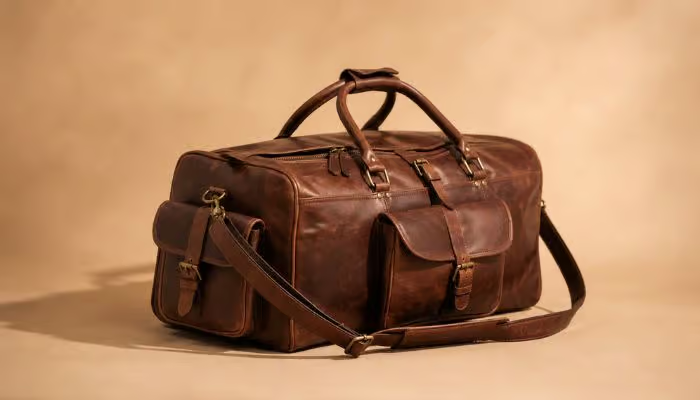
Leather gives duffle bags a more premium appearance, richer texture, and a stronger lifestyle or business-travel identity. In commercial markets, leather duffle bags are commonly used for overnight bags, executive travel bags, and luxury retail collections where material appearance plays a direct role in perceived product value.
Different leather types also create different costs and performance levels. Full-grain leather and top-grain leather are often used when the bag needs a more natural surface character and a longer-term visual appeal, while PU leather supports a similar premium look with lower production cost and easier maintenance. As a result, leather duffle bags focus less on lightweight portability and more on presentation, texture, and long-term product image.
| Material | Key Advantage | Best For | Visual Effect | Main Limitation |
| Polyester | Balances cost, weight, printing, and daily durability | Promotional duffle bags, gym bags, sports bags, retail travel bags | Smooth, clean, and versatile | Not as abrasion-resistant as higher-grade nylon |
| Nylon | Offers stronger tear resistance and abrasion performance | Outdoor duffle bags, travel bags, sports bags, and reusable products | Sleek, technical, and performance-oriented | Usually costs more than basic polyester |
| Canvas | Provides a thicker hand feel and natural fabric texture | Lifestyle duffle bags, vintage travel bags, retail collections | Natural, textured, and casual | Heavier and less water-resistant when untreated |
| RPET | Supports recycled material content and sustainability messaging | Eco-friendly promotional bags, corporate gifts, reusable travel bags | Clean, modern, and eco-conscious | Performance depends on fabric grade and coating |
| PVC | Delivers strong water resistance and easy surface cleaning | Waterproof duffle bags, outdoor bags, marine bags, gear transport | Glossy, structured, and industrial | Heavier and less flexible than textile fabrics |
| Leather | Creates premium value through texture, grain, and appearance | Luxury travel bags, business duffle bags, executive gifts | Refined, premium, and professional | Higher cost and heavier weight |
Duffle Bag vs Other Bag Types
The main difference between duffle bags and other bag types lies in the balance between storage flexibility, organization, carrying method, and item protection. Duffle bags offer flexible enclosed storage, backpacks prioritize weight distribution, tote bags favor lightweight access, and suitcases provide greater structure and protection.
The right bag type depends on the items being carried, the transport method, and the level of organization and protection required.
| Bag Type | Main Structure | Storage Style | Carrying Method | Best Use Scenarios | Main Advantage |
| Duffle Bag | Soft-sided flexible structure | Large open storage | Hand carry, shoulder carry | Travel, gym, sports, promotions | Flexible storage capacity |
| Backpack | Vertical structured body | Multi-compartment layout | Backpack carry | School, commuting, outdoor use | Better weight distribution |
| Tote Bag | Open-top lightweight structure | Simple open storage | Hand or shoulder carry | Shopping, retail, daily use | Lightweight portability |
| Suitcase | Rigid structured shell | Organized compartment storage | Rolling transport | Long-distance travel | Stronger item protection |
What Should You Check Before Bulk-Ordering Duffle Bags?
Bulk-ordering duffle bags involves more than selecting colors, sizes, or logo placement. Material quality, stitching strength, zipper performance, printing consistency, and packaging standards all affect long-term durability and commercial presentation. In travel bags, gym bags, and sports duffle bags, small production differences can quickly become visible during repeated use or large-volume distribution.

Check Stitching and Reinforcement
You should pay close attention to stitching quality because it directly affects the durability and load performance of custom duffle bags. Weak stitching often becomes one of the earliest failure points around handles, shoulder straps, zipper areas, and bottom panels where pressure concentrates during carrying and transportation.
When you inspect a travel duffle bag or sports bag sample, check stitch density, thread consistency, reinforcement placement, and stress-point construction carefully. Double stitching and reinforced webbing attachment usually improve long-term durability in repeated-use environments.
Test Zippers and Hardware
Zippers, pullers, hooks, buckles, and adjustment systems strongly affect the usability and lifespan of duffle bags. Lower-quality hardware may create opening problems, breakage, or unstable carrying performance after repeated travel or sports use.
You should test zipper movement, pull-tab strength, buckle stability, and hardware attachment before approving bulk production. Travel duffle bags and gym bags usually require smoother zipper systems and stronger hardware because they experience higher opening frequency and heavier carrying pressure.
Verify Material Strength
Fabric quality affects abrasion resistance, tear strength, shape stability, and long-term carrying performance in custom duffle bags. Thin or low-density materials may reduce initial cost, but they often wear out faster during repeated travel, sports, or outdoor use.
You should check duffle bag fabric thickness, coating quality, lining construction, and reinforcement layers carefully before approving bulk production. Different duffle bag materials can create significant differences in durability, shape stability, waterproof performance, and long-term carrying strength.
Confirm Logo and Color Consistency
Logo quality and color consistency directly influence brand presentation in promotional duffle bags, retail travel bags, and corporate merchandise projects. Small differences in print position, embroidery alignment, or fabric color can become highly visible across large-volume production.
You should confirm Pantone references, logo size specifications, print positioning, and sample approval standards before production begins. Consistent branding becomes especially important when your products enter retail stores, sports programs, or large promotional campaigns.
Evaluate Production and Packaging Standards
Production stability and packaging quality both affect the final condition of duffle bags during export transportation and warehouse storage. Weak packaging may create fabric wrinkles, shape deformation, hardware scratches, or logo damage before products even reach the customer.
Before shipment, you should confirm carton strength, packing quantity, moisture protection, barcode labeling, and transportation requirements clearly for your custom travel bags. Stable production and packaging standards also help you maintain better consistency across repeated bulk orders.
Care and Maintenance Considerations for Duffle Bags
Duffle bag care depends on material, surface treatment, logo method, and hardware construction. A polyester gym bag, canvas travel bag, PVC waterproof bag, and leather duffle bag should not be cleaned or stored in the same way. For retail and bulk orders, clear care guidance also helps reduce misuse, complaints, and premature product damage.

Material-Specific Care Requirements
Different duffle bag materials need different cleaning and storage methods. The safest approach is to match the care method with the fabric, coating, lining, and surface finish instead of using one general rule for every duffle bag.
- Polyester and nylon: Wipe surface stains with a damp cloth and mild soap, then air dry the bag in a shaded, ventilated area. For heavier stains, use gentle hand washing only when the care label allows it. Avoid bleach, high heat, and hard brushing because they may damage coatings.
- Canvas: Brush off dry dirt first, then spot clean with mild soap and cold water. Do not soak the whole bag unless allowed. Let the canvas duffle bag dry completely before storage to prevent odor, mildew, or deformation.
- PVC: Wipe PVC surfaces with a soft, damp cloth. Avoid sharp tools, strong solvents, and repeated hard folding because these may damage the coating.
- Leather: Wipe dust with a soft dry cloth. Use a slightly damp cloth for light stains, then apply leather cleaner or conditioner when needed. Keep the bag away from direct sunlight, heat, and heavy moisture.
Protection for Logos, Coatings, and Hardware
Printed logos, coatings, zippers, buckles, and metal accessories need gentle handling during duffle bag cleaning because these areas are often more sensitive than the main fabric. Strong rubbing can fade printed graphics. High heat may affect heat-transfer logos or coated surfaces. Harsh detergents may also damage color, surface finish, or hardware plating.
The main maintenance point is to clean around these areas carefully, rather than treat the whole duffle bag with the same pressure. Logo areas should not be scrubbed aggressively. Coated surfaces should not be folded sharply while wet. Zippers and buckles should stay dry after cleaning to reduce corrosion, stiffness, or poor movement.
Care Labels for Retail and Bulk Orders
Care labels matter because they turn maintenance requirements into clear instructions after the duffle bags leave the factory or supplier. A label should explain whether the bag can be wiped clean, hand-washed, air-dried, kept away from bleach, or stored in a dry place. Without clear care instructions, buyers and end customers may use cleaning methods that damage fabric, coatings, prints, or hardware.
For retail and bulk orders, care labels also help keep handling guidance consistent across stores, distributors, promotional programs, and end customers. The label should match the actual material and decoration method, not just use a generic washing symbol. If a custom duffle bag includes special coatings, trims, prints, or metal hardware, the care label should clearly state the related care limits.
Start Your Custom Duffle Bag Project with Gentle Bags
Choosing the right duffle bag involves more than selecting a shape or material. Structure design, fabric performance, storage layout, printing compatibility, and production quality all influence the final user experience and long-term product value. Whether you need travel duffle bags, gym bags, sports duffle bags, or promotional products, a well-planned design helps improve both functionality and brand presentation in commercial markets.
Gentle Bags provides custom duffle bag solutions for retail brands, wholesalers, promotional projects, sports programs, and travel-related businesses. We support material customization, logo printing, structure development, and bulk production based on your project requirements. If you are planning a custom travel bag or promotional duffle bag project, please consult us to discuss your specifications, branding needs, and production goals.
Conclusion
A duffle bag may look simple from the outside, but its real value comes from the way structure, material, size, carrying design, and maintenance requirements work together. The same product category can cover gym bags, travel bags, sports bags, outdoor bags, promotional bags, and premium retail bags. At the same time, each application places different demands on durability, comfort, storage, and appearance.
A well-designed duffle bag should match its actual use environment. Fabric strength, zipper quality, strap reinforcement, logo durability, cleaning method, and packaging standards all affect long-term performance. When these details are planned properly, a duffle bag can provide practical storage, reliable carrying performance, and consistent commercial value across different markets.
FAQs
1. Why do many duffle bags have a cylindrical shape?
Many traditional duffle bags use a cylindrical shape because the structure supports flexible packing and efficient storage for clothing, sports gear, and larger personal items. Rounded body panels also simplify construction and reduce unnecessary internal structure, which helps improve portability and production efficiency in sports and travel duffle bags.
2. What is a duffle bag mainly used for?
Duffle bags are commonly used for travel, gym activities, sports programs, outdoor transportation, and promotional projects. Different duffle bag structures and materials support different applications, ranging from lightweight gym bags and weekend travel bags to larger sports duffle bags and custom promotional products.
3. Which material is best for a durable duffle bag?
Nylon and reinforced polyester are commonly considered among the most durable materials for travel duffle bags and sports duffle bags because they provide strong abrasion resistance and better long-term performance in repeated-use environments. However, the best material still depends on the intended application, storage needs, waterproof requirements, and product positioning.
4. Are duffle bags waterproof?
Some duffle bags provide waterproof or water-resistant performance, but this depends mainly on the material and coating construction. PVC duffle bags and coated nylon travel bags usually perform better in wet environments than standard canvas or untreated fabric products.
5. What features should a good duffle bag have?
A good duffle bag should combine durable fabric, reinforced stitching, reliable zipper systems, comfortable carrying straps, and practical storage organization. In travel duffle bags and sports bags, factors such as material strength, shape stability, and storage accessibility also strongly influence long-term product performance and user experience.
6. Are duffle bags suitable for promotional and retail use?
Yes. Custom duffle bags are widely used in promotional campaigns, retail collections, corporate gifts, sports programs, and hospitality projects. Large printable surfaces, flexible material options, and broad size ranges make duffle bags suitable for both branded merchandise and commercial retail applications.