
A standard backpack size sounds like a simple number, yet brands often use different dimensions, capacities, and compartment layouts for bags that carry the same volume. This mismatch can lead to poor fit, wasted space, higher shipping costs, and products that fail to match real user needs.
Last Updated on September 23, 2026, by Gentle Bags Team
This guide explains the typical dimensions and capacity ranges behind a standard backpack size, then helps you compare usable space, match sizes to different uses, avoid common mistakes, and define practical specifications for custom production.
What Is a Standard Backpack Size?
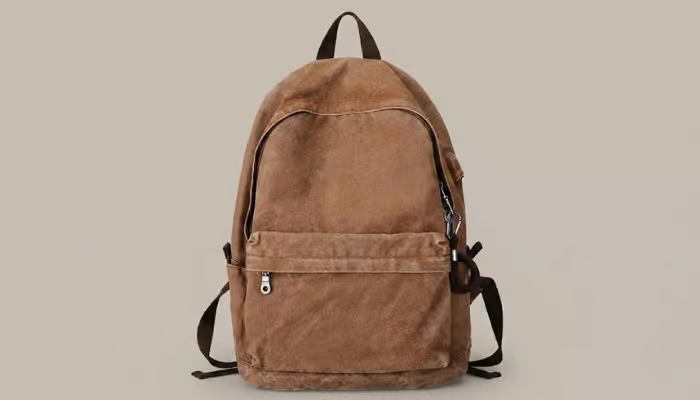
A standard backpack size does not refer to one fixed measurement because the backpack industry does not follow a universal sizing rule. For most everyday backpacks, the common size range falls between 20–30 liters, with typical dimensions of around 16–20 inches (40–50 cm) in height, 10–14 inches (25–35 cm) in width, and 5–8 inches (13–20 cm) in depth.
However, backpack size depends on the intended use, carrying needs, and structural design. A school backpack, laptop backpack, commuter backpack, and travel backpack may share similar capacities but require different dimensions. For example, school backpacks need to balance storage space, user fit, and load distribution because the American Academy of Pediatrics recommends that a loaded backpack stay below 10–20% of a child’s body weight.
Understanding Backpack Capacity vs. Dimensions
Backpack capacity and dimensions describe two different aspects of size. Capacity refers to the internal storage volume measured in liters, while dimensions describe the physical space occupied by the backpack from the outside.
A backpack with a larger capacity does not always have larger external dimensions. Internal padding, laptop sleeves, pocket structures, and reinforcement layers can reduce the available storage area. For this reason, brands should evaluate both measurements when developing backpacks for specific markets or applications.
| Measurement Type | Unit | What It Describes |
| External dimensions | Inches / Centimeters (H × W × D) | Shows the physical size of the backpack, including height, width, and depth |
| Capacity | Liters (L) | Shows the approximate internal storage volume available for carrying items |
| Internal dimensions | Inches / Centimeters | Shows the usable space inside compartments for laptops, documents, tools, or other products |
What Are the Common Backpack Size Categories?
Backpack sizes are commonly grouped by capacity to help users understand storage levels and suitable applications. Although manufacturers may define sizes differently, most backpacks fall into four practical categories: small, medium, large, and extra-large. Each category serves different carrying needs, from lightweight daily use to larger travel or equipment storage requirements.

Small
Small backpacks typically range from 10–20 liters, with dimensions of roughly 14–17 inches (35–43 cm) in height, 9–12 inches (23–30 cm) in width, and 4–6 inches (10–15 cm) in depth. A wallet, smartphone, small water bottle, and a handful of personal items fit perfectly into this compact space.
Common examples include minimalist daypacks, city backpacks, and children’s school backpacks for younger kids. They are lightweight and compact, making them ideal for short commutes or casual outings rather than heavy-duty carrying.
Medium
As the most common everyday category, medium backpacks usually offer 20–30L of capacity. Their typical dimensions range from 17–19 inches (43–48 cm) in height, 11–13 inches (28–33 cm) in width, and 6–8 inches (15–20 cm) in depth.
Whether it is a corporate laptop pack, a daily commuter bag, or a standard student backpack, they almost always share these exact proportions. It provides enough room for a 15.6-inch laptop, notebooks, a change of clothes, and daily necessities, making it a practical choice for work, school, and short trips.
Large
Large backpacks generally range from 30–45 liters, with dimensions around 19–22 inches (48–55 cm) in height, 12–14 inches (30–35 cm) in width, and 7–9 inches (18–23 cm) in depth. Optimized for extended wear during weekend travel, overnight trips, or light hiking, these packs routinely feature dedicated storage pockets, compression webbing, and rigid back panels to handle heavy loads of clothing and travel gear.
Closing out this tier with a strategic design choice, keeping the height strictly around 22 inches ensures full compliance with both FAA safety frameworks and individual carry-on size caps from major carriers like Delta, United, and American, effectively preventing last-minute friction at TSA checkpoints.
Extra-Large
Extra-large backpacks are designed for maximum storage, with capacities usually exceeding 40L and sometimes reaching 60–80L or more. Their dimensions often extend beyond 22–24 inches (55–60 cm) in height, making them suitable for multi-day travel, backpacking, and outdoor expeditions. Adjustable frames, padded hip belts, and multiple access points are common features for managing heavier loads over longer periods.
Backpack Size Categories Overview
The following table summarizes the common capacity ranges, approximate dimensions, and typical applications for small, medium, large, and extra-large backpacks. These measurements serve as practical references because actual sizes may vary depending on structure, materials, and design requirements.
| Backpack Size Category | Capacity Range | Approximate Dimensions (H × W × D) | Common Applications |
| Small | 10–20L | 14–17 in × 9–12 in × 4–6 in(35–43 cm × 23–30 cm × 10–15 cm) | Minimalist daypacks, city backpacks, children’s backpacks |
| Medium | 20–30L | 17–19 in × 11–13 in × 6–8 in(43–48 cm × 28–33 cm × 15–20 cm) | Laptop backpacks, commuter bags, student backpacks |
| Large | 30–45L | 19–22 in × 12–14 in × 7–9 in(48–55 cm × 30–35 cm × 18–23 cm) | Weekend travel, overnight trips, light hiking |
| Extra-Large | Over 40L (commonly 60–80L+) | 22–24+ in × varies by design × varies by design(55–60+ cm in height) | Multi-day travel, backpacking, outdoor expeditions |
How Are Backpack Dimensions and Capacity Measured?
Backpack dimensions and capacity describe different aspects of size, and both measurements are necessary for selecting or developing the right backpack. External dimensions show the overall size of the bag, while capacity indicates the approximate storage volume inside. The following sections explain the common measurement methods, including height, width, depth, liters, and how different backpack structures affect the final measurements.
Record Height, Width, and Depth
Backpack dimensions are usually measured at three external points: height, width, and depth. These measurements describe the overall footprint of the backpack and help determine its appearance, carrying comfort, and packaging requirements.

- Height: from the bottom of the bag to the top, excluding any extended top pockets or loose straps
- Width: Measured across the widest part of the backpack from one side to the other, usually across the front panel
- Depth: The space between the front and the back of the bag at its thickest point, which typically includes the main compartment when unzipped or slightly expanded
Calculate Capacity in Liters
Capacity, expressed in liters, is a measurement of internal volume rather than external size. It’s typically calculated by measuring the usable interior space of all compartments main compartment, front pocket, side pockets, and any laptop sleeve and adding them together.
- Geometric estimation: multiplying height × width × depth and applying a correction factor to account for the bag’s shape, since backpacks are rarely perfect rectangles.
Capacity (L) = Length × Width × Depth ÷ 1,000
- Water displacement method: filling the empty bag with a known volume of material (often foam beads or water) to measure exact internal volume.
Distinguish External Size From Usable Space
External dimensions measure the overall size of a backpack, while usable space refers to the actual storage area available inside compartments. These two measurements should be recorded separately because the outside size does not always represent the space that can be used for carrying items.

- Main and laptop compartments: Measure the internal length, width, and depth of each compartment separately, and check the laptop sleeve’s actual usable depth since padding on both sides can reduce it by 0.5–1 inch compared to the compartment’s outer dimensions.
- Additional pockets and internal structures: Evaluate storage areas for accessories while accounting for space reduced by padding, dividers, and reinforcement layers, which can noticeably shrink the space available for actual items.
During measurement, the backpack should be tested fully assembled and unzipped to its normal shape, rather than relying on flat pattern dimensions from manufacturing specs. This gives a more realistic sense of how much the finished product can actually hold, which is why two backpacks with identical exterior dimensions may still fit noticeably different amounts of gear.
Account for Different Backpack Structures
Different backpack structures require adjusted measurement methods because shape and construction can affect the final dimensions and usable capacity. A flat promotional backpack, a padded laptop backpack, and an expandable travel backpack may have similar external measurements but different storage performance.
- Structured backpacks: Measure the fixed body shape and internal storage area because rigid panels and reinforcement layers maintain a consistent form
- Soft backpacks: Evaluate the natural shape when filled because flexible materials can compress or expand during use
- Expandable backpacks: Record both the standard and expanded dimensions to show the full storage range
Why Can Equal-Capacity Backpacks Differ in Usable Size?
Two backpacks with the same capacity can provide different storage experiences because liters only measure the estimated internal volume, not how that space is organized. Padding, compartment design, backpack shape, and material structure all affect how much usable space remains for actual items. The following factors explain why equal-capacity backpacks may feel different in size and performance.

Padding and Lining Thickness
Padding adds comfort and protection, but it also occupies interior volume that isn’t available for storage. A backpack with thickly padded back panels, shoulder straps that extend into the interior seams, or a heavily cushioned laptop sleeve can lose a meaningful amount of usable space compared to a bag with minimal lining.
This is especially noticeable in laptop backpacks and camera backpacks, where protective padding is built directly into the compartment walls rather than added as a separate layer. As a direct result, a heavily armored tech commuter bag will always accommodate fewer physical items than a lightweight, unpadded nylon daypack of the same labeled volume.
Pocket and Compartment Layout
Pocket and compartment layouts influence how efficiently a backpack uses its internal volume. A backpack with multiple sections may offer better organization, but each divider, zipper panel, and separate pocket takes up space that could otherwise be used for larger items.
Backpacks with many organizational pockets, pen slots, zippered mesh compartments, and dedicated tech pouches tend to feel more restrictive when packing bulkier items, even if their total stated capacity matches a simpler, single-compartment bag.
In comparison, a simple backpack with one large compartment may hold more items of the same overall capacity because it uses more open space. This tradeoff is common in commuter and business backpacks, which prioritize organization over raw packing volume.
Backpack Shape and Gusset Depth
Backpack shape and gusset depth directly affect how much storage space users can actually use. Box-shaped backpacks usually make better use of the internal space because flat panels and consistent depth allow items such as laptops, books, and folders to fit more efficiently.
By contrast, backpacks with rounded tops, tapered shapes, or shallow side gussets may leave unused space inside the bag. These designs can create a stylish appearance, but they may reduce storage efficiency because standard items cannot fully match the curved internal structure.
Material Structure and Reinforcement
The relationship between material structure and reinforcement directly determines how a backpack performs in terms of flexibility, support, and storage efficiency. Stiffer fabrics, foam padding, and internal support panels help maintain the backpack shape and improve durability, but they can also limit flexibility when users carry bulky or irregularly shaped items.
For example, backpacks made with heavy-duty materials such as 1680D ballistic nylon or internal support sheets can provide stronger structure and better load control, but the rigid construction may reduce the ability to expand around larger items. In comparison, lightweight fabrics such as 210D ripstop polyester offer more flexibility, allowing the backpack body to adjust more easily to different contents.
Essential Backpack Features for Any Size
Whether you’re shopping for a tiny daypack or a hefty tech commuter, several essential features separate a great backpack from one that leaves your shoulders groaning before lunch. Here’s what to prioritize, no matter the size:
- Adjustable, Well-Padded Shoulder Straps: Comfortable straps should distribute weight evenly and let you dial in the perfect fit. Look for plush padding that won’t flatten out over time.
- Breathable, Supportive Back Panel: Mesh or ventilated back panels keep things cool on the move and help the bag contour to your spine—especially important for longer hauls or hotter climates.
- Sturdy Carry Handle and Reinforced Seams: A strong, easy-grab handle up top and reinforced stitching where the straps meet the body mean your bag will survive overhead bins, locker shoves, and spontaneous airport sprints.
- Thoughtful Internal Organization: Whether it’s a padded laptop sleeve, zippered mesh pockets for chargers, or a quick-stash exterior pouch for keys, smart storage helps keep essentials sorted (and your sanity intact).
- Easy Access Design: Top-loaders, U-shaped clamshells, or zip-around openings let you get to your gear without unpacking your entire life on the sidewalk. Choose a closure style that suits how you use your bag most often.
It’s the combination of these core features—regardless of brand or specific purpose—that transforms a basic backpack into an everyday sidekick that works as hard as you do.
Standard Backpack Sizes for Different Uses
Different applications require different backpack dimensions because the ideal size depends on the items carried, user expectations, and functional requirements. Instead of choosing a backpack size based solely on capacity, brands usually define standard dimensions based on the specific use case.
School and Campus

School and campus backpacks commonly use a 20–25L capacity range, with a standard footprint of around 18“ × 12“ × 7“ (45 × 30 × 18 cm). Maintaining comfortable daily carrying while offering enough room for heavy textbooks, folders, and laptops requires a geometric balance popularized by JanSport‘s classic campus series, which became a de facto benchmark for everyday student bag dimensions.
For younger students, the industry standard drops to around 12–15L (14 × 10 × 5 inches / 35 × 25 × 13 cm) to match smaller body proportions while still carrying essential school items. Sizing down to these compact dimensions directly addresses early spine protection, a design priority embedded in Pottery Barn Kids‘ youth lines, where lightweight, scaled-back frames replace bulky adult structures.
Work and Commuting

Navigating crowded transit lines or corporate boardrooms typically calls for a streamlined 15- to 22-liter silhouette with a slim depth under 6 inches (15 cm). Professional environments heavily favor device security and aerodynamic low-profile designs over bulky storage.
Mirroring this premium corporate aesthetic, the leather backpack from Samsonite compresses essential tech storage into a tight 17.5“ x 12“ x 5.5“ (44.5 x 30.5 x 14 cm) perimeter, a common industry footprint developed to lock a 14-inch to 16-inch laptop flush against the wearer’s back.
Restricting the bag’s depth in this manner keeps the center of gravity close to the body, successfully preventing a fully packed bag from shifting awkwardly or looking sloppy when worn over a sharp business suit.
Gym and Sports
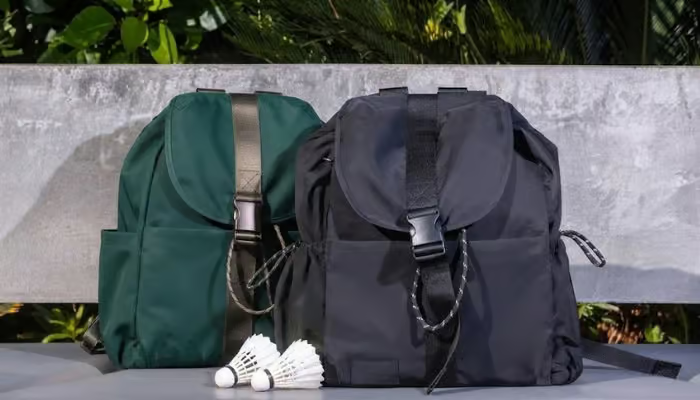
Gym and sports backpacks typically require a 25–35L capacity range to accommodate clothing, towels, shoes, water bottles, and training accessories. Common dimensions are around 19″× 13“ × 8.5“ (48 × 33 × 22 cm), with a deeper structure that provides more room for bulky and irregularly shaped items.
Unlike slim commuter backpacks, gym backpack designs usually need additional depth because items such as shoes and workout gear do not fit efficiently into flat compartments. For example, Nike offers training backpacks such as the Brasilia series with around 30L capacity, featuring practical storage layouts for gym essentials.
25–35L: All-Day & Active Use
Ideal for:
- Hitting the gym before or after work
- Packing for sports practices or games
- Carrying an extra set of clothes, shoes, and personal care items
- Fitting in snacks, water bottles, and tech without feeling overloaded
This capacity range offers a practical balance between spaciousness and everyday portability. Whether you’re heading to a workout, a pickup soccer match, or just need to transition smoothly from the office to the gym, a 25–35L backpack provides the right amount of room for layers, gear, and daily essentials. The deeper and more flexible structure means you won’t struggle to fit in awkwardly shaped items or find space for that extra towel.
For those who need to stay organized on the move, look for backpacks with dedicated compartments for shoes, wet gear, and water bottles. Adjustable straps and padded backs also boost comfort for all-day wear, whether you’re navigating public transit or walking across campus.
In short, the 25–35L range is the sweet spot for anyone who needs a reliable, versatile gym or sports backpack that keeps up with active and unpredictable schedules.
Overnight and Short Trips

Overnight and short-trip backpacks usually fall within a 30–45L capacity range, providing enough space for clothing, toiletries, electronics, and travel essentials for a 2–3 day journey. A common size reference is around 21–22 inches (53–56 cm) in height, 13–14 inches (33–35 cm) in width, and 8–9 inches (20–23 cm) in depth, balancing storage needs with portability.
Travel backpack designs often follow compact carry-on-friendly proportions. For example, Osprey Farpoint 40 is designed around approximately 22“ × 14“ × 9“ (55 × 35 × 23 cm), offering a travel-focused layout with organized compartments and suitcase-style access.
Carry-On and Front-Access Features
When your backpack needs to double as your main luggage, structure, organization, and comfort move to the top of the priority list. For air travel, most airlines allow carry-on bags up to roughly 45 liters, making backpacks in the 30–45L range ideal for flights, train rides, or bus journeys.
Backpacks in this category are designed for:
- Efficient packing of clothes and toiletries for quick overnight or weekend trips
- Smart internal organization to separate tech from apparel
- Comfortable carry through airports, stations, and city streets
- Maximized storage without sacrificing mobility or exceeding carry-on limits
For most travelers, 30–40L sits right in the sweet spot—spacious enough for essentials, yet compact enough to maneuver easily and fit in overhead bins. Look for suitcase-style zippers, padded laptop sleeves, and ergonomic straps to make your travel smoother, whether you’re dashing through a terminal or settling in for a city break.
What Features Should You Look For in a Carry-On Travel Backpack?
When your backpack serves as your main luggage for flights or cross-country train rides, its features become just as important as its size. The right travel backpack doesn’t just fit in the overhead bin—it keeps your journey organized, efficient, and comfortable from check-in through arrival.
Key features to consider in a carry-on travel backpack include:
- Carry-On Approved Dimensions: Most airlines set the maximum for carry-on luggage at about 45 liters or around 22″ x 14″ x 9″ (55 × 35 × 23 cm). Seek backpacks specifically designed to meet these requirements, such as the Osprey Farpoint 40 or the Patagonia Black Hole series, for seamless passage through airport gates.
- Clamshell or Wide-Opening Access: Suitcase-style openings make it easier to pack and find items without digging or disrupting carefully folded clothes.
- Organized Compartments: Look for bags with dedicated pockets for laptops, electronics, and smaller accessories—keeping travel documents or chargers at your fingertips and separating clean clothes from shoes or laundry.
- Comfortable Support: Adjustable, padded shoulder straps, sternum straps, and ventilated backs are essential for carrying heavier loads across terminals or city streets.
- Durable Construction: Reinforced stitching, water-resistant materials, and strong zippers ensure the backpack can withstand the bumps of travel.
- Easy Mobility: Streamlined shapes prevent snagging on airplane seats or train aisles, while side and top grab handles add flexibility for lifting or quick transitions.
A backpack that checks these boxes makes one-bag travel far less stressful—allowing you to move easily from airports to city sidewalks without sacrificing organization or comfort.
How to Choose the Right Backpack Size?
Choosing the right backpack size requires more than selecting a capacity number. The ideal size should match the intended use, the items being carried, the user’s body requirements, and the backpack structure.
For personal selection and custom backpack development, the process usually starts by identifying the required contents and then confirming the dimensions, capacity, and construction details that support those needs. The following factors help determine a practical backpack size before production or purchase.

Key Questions to Ask Before Selecting a Backpack Size
To ensure your backpack meets all your needs—whether for daily commutes, gym sessions, or spontaneous weekend getaways—it pays to pause and consider a few practical questions:
- How many days of use will the bag need to accommodate at a time? Determining the typical trip length (from single-day errands to multi-day travel) sets the groundwork for appropriate capacity.
- What sort of environment will you be navigating? Will you be weaving through crowded subway stations, racing from class to class, or trekking on hiking trails?
- Are there any transportation restrictions to consider? For instance, will you need your backpack to comply with airline carry-on size limits (think about the dimensions used by Osprey or Samsonite)?
- What primary items will you be carrying? Consider if your load will include bulky gym shoes, delicate electronics, work essentials, or just everyday accessories.
- How much organization and protection do you require? Decide if you need padded compartments for a laptop, separate pockets for toiletries, or expandable storage for those unexpected extras.
- What are your comfort and fit preferences? Reflect on the bag weight when fully packed, strap design, and whether the bag will sit comfortably on your frame—especially if you’ll be wearing it for extended periods.
Reflecting on these points will help narrow down the ideal backpack dimensions and features, ensuring you invest in a bag that’s not just stylish, but also perfectly suited to your practical realities.
Identify the Required Storage Capacity
The right backpack capacity depends on the amount and type of items the backpack needs to carry. Instead of choosing a size based only on appearance, brands should match the storage volume with the actual carrying requirements.
Backpack capacity is typically measured in liters—a standard that helps compare different models more effectively than simply looking at external dimensions. Because backpacks are designed to fit closely against the body, with curved panels and ergonomic shapes, liters offer a practical way to estimate usable space. A helpful rule of thumb: one liter is roughly equivalent to a standard water bottle. So, a 30L backpack can hold about 30 such bottles. While not a perfect measurement, this visualization makes it easier to gauge if a backpack will suit your needs.
| Carrying Requirements | Recommended Capacity | Typical Contents |
| Light daily essentials | 10–20L | Wallet, phone, tablet, small accessories, water bottle |
| School and office essentials | 20–30L | Laptop, notebooks, documents, chargers, daily items |
| Sports and fitness gear | 25–35L | Clothing, shoes, towel, training accessories |
| Short trips and travel items | 30–45L | Clothes, toiletries, electronics, travel essentials |
When evaluating options, focus on the internal volume rather than just the bag’s appearance or exterior size. This ensures you select a backpack with enough capacity for your actual contents, whether you’re packing for a gym session, a day at the office, or a weekend getaway.
Consider User Fit and Carrying Comfort
Storage capacity alone does not determine whether a backpack fits comfortably. The height, back panel length, and strap position must also match the user’s body proportions to keep the load stable and reduce unnecessary pressure during carrying.
- Adult fit: Adult backpacks often use a 17–19 inch (43–48 cm) back panel height as a general reference, but the final dimensions should be adjusted based on torso length rather than gender alone. Women’s and men’s backpacks may use different strap curves, shoulder widths, or back contours to improve fit.
- Youth fit: Children’s backpacks usually require shorter back panels, with school bags often staying around 14 inches (35 cm) or less to better match smaller body proportions.
- Load distribution: A properly sized backpack should keep heavier items close to the body and use suitable shoulder straps and back support to reduce carrying pressure.
- Backpack size and backpack fit are not the same thing. A well-fitted 25L backpack will always feel better than an oversized pack that doesn’t sit right. Test different backpacks by loading them with weight, adjusting the straps, and paying attention to how the load distributes across your shoulders and back. The right fit will make a significant difference in comfort, especially over long periods of wear. Whenever possible, choose comfort first: a pack that fits your frame and distributes weight evenly will outperform a larger or more feature-rich option that doesn’t sit properly.
Balance Functionality and Backpack Dimensions
Adding premium features like thick protective foam, structural rigid frames, or expanding zippers alters a bag’s exterior footprint without adding usable space. Balancing these elements requires making clear dimensional trade-offs to ensure the finished product aligns with its core market positioning.
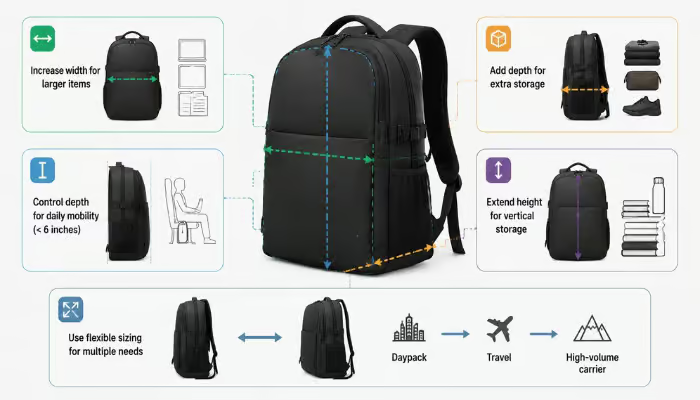
- Increase width for larger items: Where wide laptops, documents, or rigid folders dictate the internal clearance, expand the horizontal profile instead of making the bag unnecessarily tall.
- Add depth for extra storage: If dense internal padding eats away at usable volume, increase the front-to-back dimension to successfully restore storage capacity for bulkier contents.
- Control depth for daily mobility: To serve transit commuters demanding a sleek, low-profile silhouette, cap the maximum backpack thickness strictly under six inches.
- Extend height for vertical storage: For loads consisting primarily of stacked textbooks or elongated items, choose an extended vertical frame to compress the pack’s overall width.
- Use flexible sizing for multiple needs: By adopting a multi-zipper expandable footprint, a single frame can dynamically transition from a compact daypack to a high-volume carrier.
Review Samples With Realistic Loads
A backpack’s final size cannot be fully evaluated through measurements alone. A sample test with realistic loads helps brands confirm whether the dimensions, capacity, and internal layout work properly in actual use.
- Item fitting: Place the intended products inside the backpack to verify that laptops, documents, equipment, or daily items fit as expected.
- Carrying balance: Test the loaded backpack to check whether the weight sits comfortably on the back and whether the straps support the intended load.
- Space utilization: Evaluate whether compartments provide practical storage or whether padding, dividers, and internal structures reduce usable space.
- Overall appearance: Review the backpack shape after loading to ensure it maintains the expected profile without excessive bulging or distortion.
5 Critical Backpack Sizing Mistakes to Avoid
Backpack sizing mistakes often happen when brands focus on one measurement instead of evaluating the complete product requirements. Capacity, dimensions, user fit, and real carrying conditions all influence whether a backpack performs well in the market. Avoiding these common mistakes helps brands reduce redesign costs and create products that match actual user expectations.

Relying Only on Liter Capacity
Liter capacity provides a general measurement of storage volume, but it does not fully represent how a backpack performs in daily use. Two backpacks with the same capacity may have different usable space because of padding thickness, compartment design, lining materials, and structural support.
Ignoring dimensions and internal layout can lead to fitting issues, especially for products such as laptops, documents, or equipment with fixed shapes. Capacity should be evaluated together with height, width, depth, and storage arrangement.
Ignoring User Fit and Carrying Weight
A backpack size that fits the contents may still feel unsuitable if it does not match the intended wearer or carrying conditions. Excessive height, depth, or overall weight can affect balance and make the bag less comfortable during extended use.
For school, commuting, and travel backpacks, shoulder strap design, back panel support, and load distribution should be considered alongside size. A properly sized backpack keeps the load closer to the body and reduces unnecessary carrying pressure.
Overlooking Laptop and Document Fit
Many backpack sizing issues happen when designers estimate capacity without checking the dimensions of actual items. Laptops, tablets, folders, and documents often require specific compartment measurements rather than general storage space.
Backpacks may have enough total volume but still fail to fit a larger laptop or standard document size if the main compartment is too narrow or too short. Internal dimensions should be confirmed before finalizing the backpack size.
Choosing More Capacity Than Needed
Larger backpacks may seem more versatile, but excessive capacity can create unnecessary bulk and reduce everyday practicality. Oversized designs may encourage overloading, increase empty bag weight, and make the backpack less suitable for urban commuting or retail positioning.
The ideal size should provide enough room for regular items while maintaining a balanced shape. Matching capacity with the primary use scenario creates a more efficient and comfortable product.
Skipping Loaded Sample Tests
Size decisions based only on drawings or measurements may overlook real-world issues that appear after loading. A physical sample allows you to check how the backpack holds its shape, distributes weight, and accommodates actual contents.
Before bulk production, loaded testing can reveal problems with compartment access, strap position, balance, and overall dimensions. This step helps confirm that the final backpack size performs as expected in practical use.
Work with Gentle Bags to Define the Right Backpack Size
At Gentle Bags, we help brands define backpack specifications based on target users, carrying requirements, product structure, and market positioning. Our team supports size planning, compartment design, material selection, and sample evaluation to ensure the final backpack meets practical usage needs.
From school backpacks and laptop backpacks to travel, sports, and promotional bags, Gentle Bags provides OEM/ODM solutions for brands, wholesalers, and procurement teams. Contact us to discuss your custom backpack size requirements and develop a backpack design that matches your market, product goals, and production expectations.
Conclusion
A standard backpack size is not defined by one universal measurement. The right dimensions depend on capacity requirements, intended use, user fit, and the way internal space is organized. From everyday 20–30L backpacks to larger travel designs, successful sizing decisions come from matching the backpack structure with real carrying needs.
For brands developing custom backpacks, accurate size planning helps improve product performance, user satisfaction, and production efficiency. By evaluating contents, dimensions, samples, and logistics requirements before manufacturing, companies can create backpacks that deliver the right balance between storage, comfort, and market appeal.
FAQs
1. What is the standard backpack size?
There is no single universal standard backpack size because manufacturers design backpacks for different purposes and users. For everyday use, the most common range is 20–30L, with typical dimensions around 16–20 inches (40–50 cm) in height, 10–14 inches (25–35 cm) in width, and 5–8 inches (13–20 cm) in depth.
2. What size backpack is best for everyday use?
A 20–30L backpack is usually the most practical choice for everyday use. This size can typically accommodate a laptop, notebooks, documents, chargers, a water bottle, and personal items while maintaining a comfortable profile for commuting, school, or office use.
3. How many liters is a normal school backpack?
Most school backpacks fall within the 15–30L range, depending on the student’s age and carrying requirements. Younger students usually need smaller backpacks around 12–15L, while older students and college users often require 20–30L for textbooks, folders, and laptops.
4. What backpack size fits a 15.6-inch laptop?
A backpack designed for a 15.6-inch laptop usually needs a capacity of around 20–30L, depending on the number of additional items carried. The internal laptop compartment should be checked separately because a backpack’s total liter capacity does not always indicate laptop compatibility.
5. Is a 30L backpack too big for daily use?
A 30L backpack is not necessarily too large for daily use. It works well for commuters, professionals, and students who carry larger laptops, documents, clothing layers, or additional equipment. However, users who only carry essentials may find a 20–25L backpack more compact and comfortable.